If your drain keeps clogging after every snake job, there's a reason. Here's what's actually happening inside your pipes — and what fixes it for good.
Share:

Summary:
If you’ve had a drain snaked and found yourself calling a plumber again six months later, you’re not imagining things — and it’s not bad luck. The drain was never actually cleaned. It was just opened up enough to flow again.
That’s the difference between snaking and hydro jetting, and it’s a distinction that matters a lot in Cook County, where the pipes under most homes have been in the ground for 50 to 100 years. Here’s what each method actually does, when one is the right call over the other, and what we’ve learned doing this work since 2000.
Hydro jetting uses high-pressure water to clean the inside of a drain or sewer line — not just punch through a clog, but scour the entire interior surface of the pipe. A flexible hose is fed through a cleanout access point, and a specialized nozzle at the end shoots water in two directions at once: forward to break up whatever’s blocking the line, and backward to flush all of it out of the system.
The pressure involved is serious. Our professional equipment operates at over 4,000 PSI. That’s enough to cut through grease buildup that’s been coating a cast iron pipe for decades, blast apart root masses that have worked their way through a sewer lateral joint, and strip mineral scale off pipe walls entirely. When the job is done, the pipe interior looks close to what it did when it was first installed.

This is where it gets specific — because the answer isn’t just “clogs.” Hydro jetting removes the stuff that builds up on pipe walls over time and slowly narrows the pipe’s effective diameter until water barely moves through it at all.
In Cook County’s older homes — the bungalows, two-flats, and three-flats built between 1900 and 1950 that make up so much of the South and Southwest Side housing stock — the drain systems are almost always cast iron. Cast iron is durable, but it’s also porous and rough on the inside. Grease sticks to it. Soap scum layers on top of grease. Minerals from hard water deposit on top of that.
Over years and decades, what was once a four-inch pipe starts behaving like a two-inch pipe. A snake can create a temporary opening through that mass. It cannot remove the mass itself.
Hydro jetting removes all of it — grease, scale, soap buildup, sediment, and fine root tendrils that have grown into the line through joint gaps. The high-pressure jets don’t leave a hole in the obstruction; they remove the obstruction from the pipe wall entirely and flush everything downstream and out of the system.
Cook County’s residential neighborhoods are full of mature trees — the parkway elms and oaks that line blocks throughout Gage Park, Bridgeport, Archer Heights, and dozens of other communities. Those root systems find their way into sewer laterals through even the smallest joint separations, and once they’re in, they grow.
A drain snake can break through a root mass, but root material stays in the pipe and regrows. Hydro jetting cuts the roots and flushes them completely, which is why it delivers results that last significantly longer in areas with heavy tree coverage.
One more thing hydro jetting handles that snaking doesn’t: it’s the required pre-treatment before any pipe lining work. If your sewer lateral is being lined with a CIPP (cured-in-place pipe) liner, the pipe has to be completely clean for the liner to bond correctly. That means hydro jetting first — no exceptions.
This is the most common concern we hear, and it’s a fair one — especially from homeowners in Cook County whose pipes have been in the ground since the Eisenhower administration. The honest answer is: yes, when it’s done correctly. The key phrase there is “done correctly.”
Before any hydro jetting service, a camera inspection of the line is required. This isn’t optional and it isn’t upselling — it’s the step that makes everything else safe. The camera tells us what we’re working with: the pipe material, the condition of the walls, whether there are any existing cracks or joint separations that could be worsened by high pressure.
If the pipe is in bad shape, we’ll tell you that before we start, because jetting a compromised pipe without knowing it’s compromised is how damage happens.
When the pre-service inspection confirms the pipe can handle the pressure, jetting is safe for cast iron, PVC, copper, and clay tile. Pressure settings can be adjusted based on what the camera shows. The process is controlled, not blunt-force.
We also perform a camera inspection after the service so you can see exactly what the pipe looks like when we’re done — not just take our word for it. Customers consistently tell us that seeing the before-and-after footage is the moment the service makes complete sense to them. It removes all the guesswork.
The pipes that genuinely aren’t candidates for hydro jetting are the ones that are already structurally failing — severely cracked, collapsed, or so deteriorated that water pressure of any kind would accelerate the damage. In those cases, the camera will show us that, and the conversation shifts to repair or replacement. That’s a different situation entirely, and it’s one we’d rather identify before we start than discover mid-job.

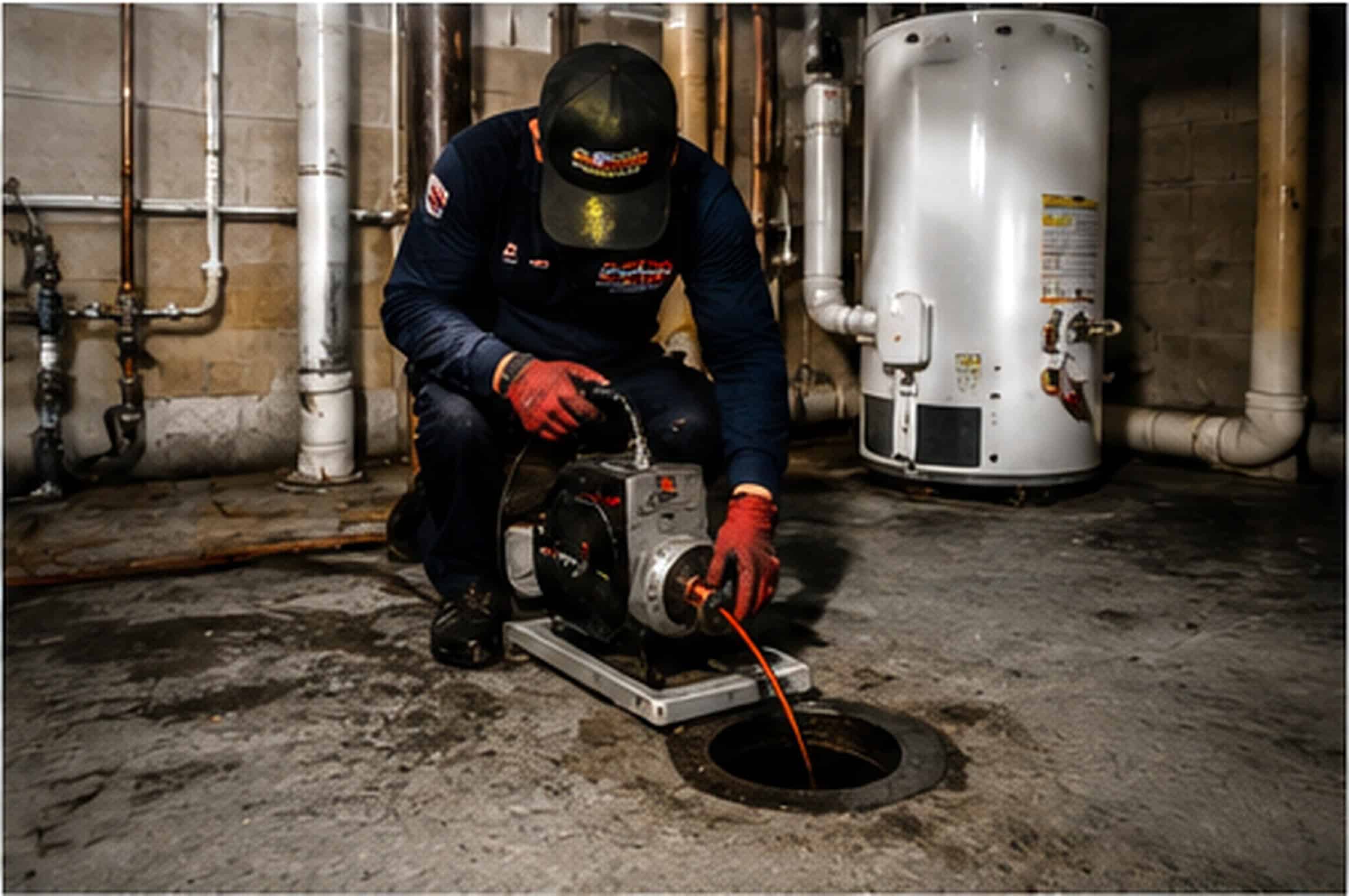
A drain snake — also called a drain auger, or “rodding” in Chicago — is a long, flexible metal cable that a plumber feeds into a drain line. At the end is a corkscrew-style tip that rotates as it advances, drilling through whatever is blocking the pipe and creating an opening for water to flow through again.
Snaking is fast, relatively inexpensive, and genuinely effective for certain situations. A single, localized blockage — a clump of hair in a bathroom drain, a small food debris clog near a kitchen trap — is exactly what a snake is designed to handle. If the pipe is otherwise clean and in good condition, snaking can clear that kind of clog completely and leave you with a drain that flows normally for years.
The problem is that snaking is often used in situations where it was never going to be a permanent fix.
This is the question that sends most people searching for hydro jetting in the first place. You’ve had the drain snaked. It works. Three months later, same problem. You call again, pay again, it works again. Then it backs up again. The cycle is exhausting, and it feels like something is being missed — because something is.
When a plumber snakes a drain, the cable advances until it hits the blockage, then rotates to break through it. That creates an opening. Water flows. The job looks done. But what the snake doesn’t do is touch the pipe walls. The grease coating the inside of the cast iron line is still there. The mineral scale is still there. The layer of buildup that caused the clog to form in that spot in the first place is still there.
The snake punched a hole through the problem. It didn’t remove the problem.
Within weeks or months, that residual buildup catches new material — more grease, more debris, more root growth — and the opening closes again. The drain backs up in the same spot because the same conditions are still present. This is the recurring clog cycle, and it’s extremely common in Cook County homes with older cast iron drain systems that have never been thoroughly cleaned.
The frustrating part is that the snake job isn’t wrong exactly — it’s just the wrong tool for what the pipe actually needs. Snaking is a temporary fix applied to a chronic condition. Hydro jetting addresses the chronic condition itself. That’s the distinction that matters when you’re tired of paying for the same repair over and over.
It’s also worth putting the math plainly. Snaking a drain multiple times a year adds up. If you’re calling a plumber for the same drain repeatedly, the cumulative cost of those service calls can exceed what a single hydro jetting service would have cost — and the drain still isn’t clean. We’ve seen this pattern in homes across Cook County more times than we can count.
Snaking is the right call in specific situations, and we’ll tell you that directly rather than push a more expensive service when a simpler one will do the job.
If you have a one-time, isolated clog — something that’s never happened in that drain before, in a pipe that’s otherwise in good shape — snaking is often all you need. Hair clogs in a bathroom drain, a small obstruction near a fixture trap, a first-time slow drain in a newer home: these are situations where a snake does exactly what it’s supposed to do, and there’s no reason to bring out high-pressure jetting equipment.
Snaking is also faster and less involved. For a simple clog in a secondary drain, it can be resolved in under an hour with minimal disruption. When the situation calls for a quick, targeted fix, snaking delivers that.
The situations where snaking falls short are predictable: recurring clogs in the same drain, slow drains throughout the house (which usually signal a main line issue rather than a fixture-level problem), grease buildup in a kitchen line, root intrusion in a sewer lateral, or any drain that’s been snaked multiple times in the past year without lasting results. Those are the situations where hydro jetting is the appropriate tool — not because it’s more expensive, but because it’s the only method that actually addresses what’s causing the problem.
Cook County’s housing stock makes this distinction particularly relevant. A significant portion of our service area was built before 1960, which means cast iron drain systems that are now 60 to 100 years old. Those pipes have decades of accumulated buildup that no amount of snaking will remove. Calling them “clogged” undersells the situation — they’re coated, narrowed, and in many cases partially obstructed throughout their entire length, not just at one point. For those pipes, hydro jetting isn’t an upgrade. It’s the appropriate response to what’s actually there.
Article details:
Share:
Continue learning: