
Drain camera or sewer camera — the difference matters more than most homeowners realize. Here's how to know which one you actually need.
Share:

Summary:
You’ve had the slow drain. Maybe the basement backup after a hard rain. You’ve tried the chemicals, maybe even called a plumber who snaked it and called it done — and two months later, you’re back to square one. At some point, someone tells you that you need a camera inspection. That’s probably true. But here’s something most plumbers don’t bother explaining: there’s more than one kind of camera, and the right one depends entirely on where your problem actually lives. Get that wrong, and you’re either missing the issue entirely or paying for a scope you didn’t need.
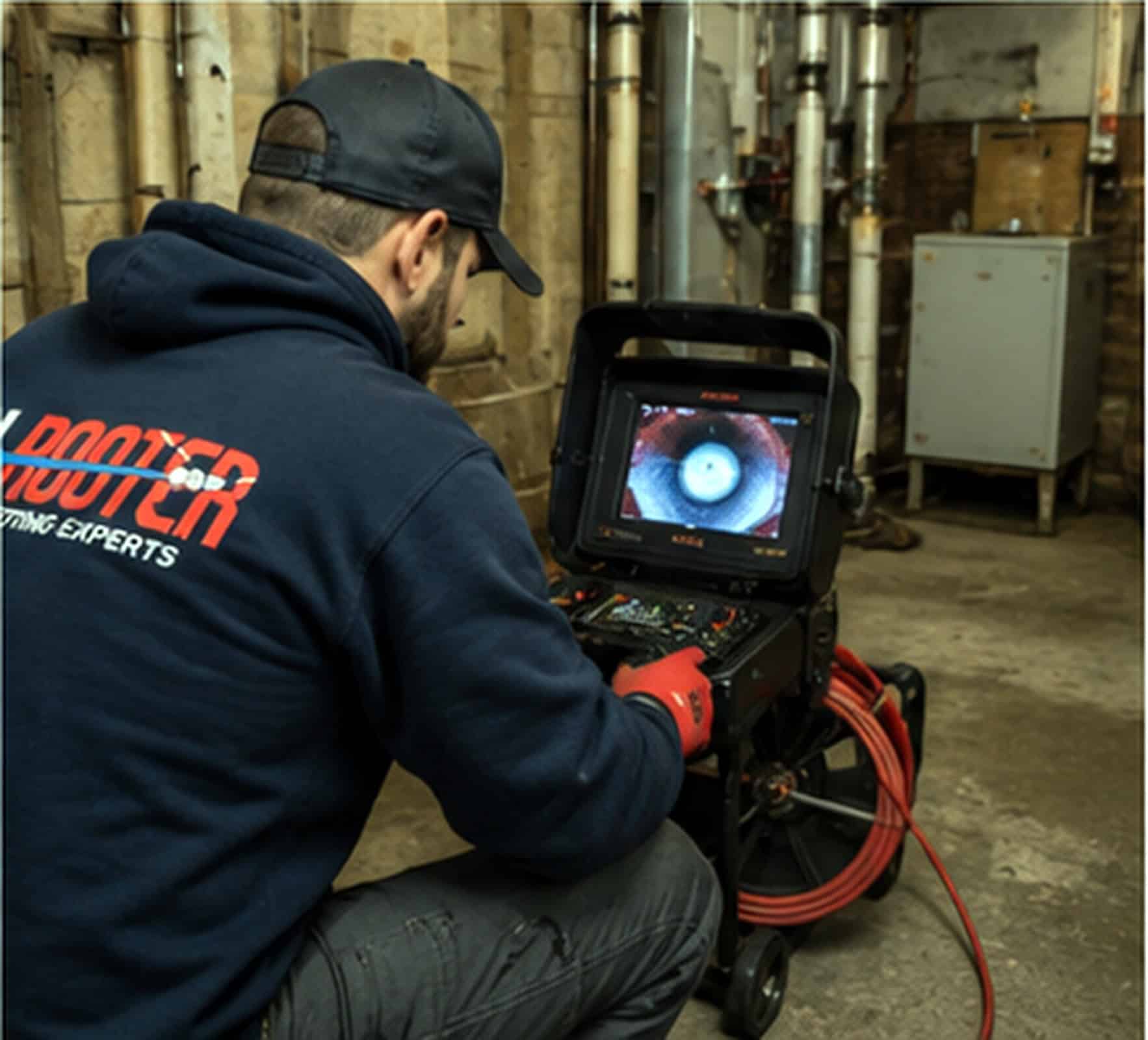
A pipe inspection camera — sometimes called a sewer camera, drain camera, or CCTV pipe camera — is a flexible cable with a waterproof camera head and LED lighting attached to the end. We feed it into your pipe through a cleanout or drain opening, and the footage streams in real time to a monitor. What you’re seeing is the actual interior of your plumbing — corrosion, blockages, root intrusion, cracked joints, offset sections — all of it visible without digging up a single inch of your yard.
The technology itself isn’t new, but the quality has improved significantly. Professional-grade cameras produce clear footage even in corroded or partially blocked pipes, and most are equipped with a locator transmitter that lets us mark the exact location of a problem on the surface above. That last part matters more than people realize — it’s what separates a useful inspection report from a vague verbal summary.
This is the question most homeowners never think to ask — and it’s the one that determines whether the inspection you’re paying for will actually find your problem.
A drain camera, also called a push camera or mini camera, is designed for shorter branch lines inside your home. Think the kitchen drain, a bathroom sink line, a tub drain, or a laundry standpipe. These are smaller-diameter pipes — typically 1.5 to 4 inches — with tighter bends that a larger camera can’t navigate. A drain camera is the right tool when the problem is somewhere between your fixture and the main stack. It’s compact, maneuverable, and built for the confined spaces inside a house.
A sewer camera is a different animal. It’s built for the main sewer lateral — the pipe that runs from your home’s foundation out to the city main under the street. These runs can be 30, 60, or even 100+ feet long, and the pipe diameter is typically 4 inches or larger. Sewer cameras are heavier-duty, travel farther, and critically, they carry a locator transmitter that broadcasts a signal to the surface. That signal lets us walk the path of your pipe above ground and mark exactly where a root ball, crack, or offset joint is sitting — information that’s essential if any excavation or trenchless repair is on the table.
Here’s why this distinction matters in practice: if your kitchen sink keeps backing up no matter how many times it’s snaked, the problem is likely in the branch line — and a drain camera is the right diagnostic. But if your basement floods during heavy rain, or if multiple fixtures in the house are slow at the same time, the problem is almost certainly in the main lateral — and you need a sewer camera with a locator to find it. Using a drain camera on a main-line problem is like using a flashlight to look for something buried underground. You might see something, but you won’t know where it is or how to get to it.
In Cook County, where a large share of homes were built before World War II, this distinction carries extra weight. The sewer laterals in neighborhoods like Archer Heights, Brighton Park, Bridgeport, and Berwyn are often original clay tile — 70 to 100 years old, with joints that have shifted and separated over decades of Chicago freeze-thaw cycles. A sewer camera with a locator doesn’t just find the problem. It tells us exactly where to dig, or whether trenchless repair is even an option.
Most of Cook County is served by municipal sewer, but not all of it. Unincorporated areas and some outer suburbs still rely on private septic systems — and when those systems have problems, a standard sewer camera isn’t the right tool either.
A septic camera inspection is a specialized variant used to inspect the internal components of a septic system: the inlet and outlet baffles inside the tank, the distribution box that routes effluent to the leach field, and the leach field pipes themselves. These components fail in ways that a standard lateral inspection won’t catch. A cracked outlet baffle, for example, can allow solids to escape into the leach field and cause a system failure that looks like a slow drain from inside the house — but has nothing to do with the lateral at all.
The inspection process is also different. Access points on a septic system are specific to the tank’s design and location, and the camera work is typically coordinated with a tank pumping so we have a clear view of the baffles and internal walls. In Illinois, septic systems fall under county health department jurisdiction rather than the state plumbing code, which means the inspection documentation requirements are different from what you’d need for a municipal lateral repair or permit application.
If you’re in an unincorporated part of Cook County and you’re not sure whether your property is on municipal sewer or septic, that’s actually the first thing worth finding out — because the answer determines everything about what kind of inspection makes sense, what the findings mean, and what the repair path looks like. We’ve worked with homeowners who spent money on lateral inspections when their actual problem was a failing septic baffle. Getting the right camera into the right system from the start saves time, money, and a lot of unnecessary frustration.
The value of a camera inspection isn’t just that it finds a blockage. It’s that it shows you what kind of blockage you have, what condition the pipe is in, and what the right fix actually is. Those three things together are what turn a diagnostic into a decision.
In Cook County’s older housing stock, the findings tend to cluster around a few common problems. Root intrusion is the most frequent — Chicago’s tree-lined streets are beautiful, but the root systems of mature elms and oaks actively seek moisture in clay tile joints. Tuberculation is common in cast iron pipes: internal rust buildup that narrows the pipe diameter over years until flow is severely restricted. Galvanized steel lines, found in many pre-1960 homes, corrode from the inside out and develop scale buildup that no amount of snaking will permanently clear.

This is the question homeowners should be asking before they book any inspection — and it’s one that a lot of plumbing companies don’t answer clearly upfront.
When a camera inspection identifies a problem, the findings should come with two things: a complete video recording of the pipe system and a written report that documents what was found, where it’s located (marked by distance from the entry point), and what the repair options are. That documentation matters because it lets you make an informed decision — not a pressured one. If a plumber shows you camera footage and immediately pivots to a repair quote without giving you time to process what you’re seeing, that’s a red flag.
The repair path depends entirely on what the camera reveals. A root intrusion in an otherwise structurally sound clay tile lateral is often best addressed with hydro jetting — high-pressure water that clears the roots and flushes the line clean. We perform a camera pass after the jetting to confirm the blockage is gone and the pipe is flowing freely. That two-step process — camera before jetting, camera after — is how we work on every hydro jetting job, because it’s the only way to know the line is actually clear and not just temporarily improved.
If the camera reveals something more serious — a collapsed section, a severely offset joint, a pipe that’s deteriorated past the point where cleaning will help — then the conversation shifts to repair or replacement. Trenchless lining, spot repair, or full lateral replacement are all options depending on the extent of the damage. But here’s the critical point: none of those decisions should be made without camera evidence. A plumber who recommends excavation without showing you footage of why it’s necessary is asking you to take their word for something that could cost thousands of dollars. You deserve to see what we’re seeing.
In Cook County’s bungalow belt, where laterals are often original clay tile running 30 to 60 feet from the foundation to the street, a camera inspection with a locator is frequently what determines whether a homeowner needs a $400 hydro jet or a $10,000 lateral repair. That’s not a small distinction. The inspection is the decision point — not just a preliminary step before the real work begins.
The honest answer is: sooner than most people do. By the time a drain stops flowing entirely, the problem has usually been developing for months — and what might have been a straightforward hydro jet has become a more involved repair.
There are a few situations where a camera inspection is clearly the right call. If you have a recurring backup that keeps returning after snaking, the snake is clearing a symptom, not a cause — and a camera is the only way to find out what’s actually going on in the pipe. If multiple fixtures in your home are draining slowly at the same time, that points to a main-line issue, not a branch-line clog. If your basement floods during heavy rain, a camera inspection can determine whether the problem is in your lateral, your flood control system, or whether the city main is involved — which matters a great deal for figuring out who’s responsible for the fix.
Spring is a particularly active season for camera inspection calls in Cook County. Chicago’s freeze-thaw cycles move the ground significantly over winter, and clay tile joints that were holding in October can be shifted or cracked by March. We see a lot of homeowners discover winter damage in the spring that wasn’t visible the previous fall — and catching it early makes a real difference in what the repair looks like.
Pre-purchase sewer scopes are another scenario worth mentioning. If you’re buying a home in Cook County — especially anything built before 1960 in neighborhoods like Cicero, Berwyn, Oak Lawn, or anywhere in the Southwest Side — a sewer scope before closing is one of the most valuable inspections you can get. The sewer lateral isn’t visible in a standard home inspection, and inheriting a deteriorated clay tile lateral with root intrusion can mean a significant repair bill within the first year of ownership. A camera inspection before closing gives you either peace of mind or negotiating leverage. Either way, it’s information you want before you sign.
If you’ve been told by a previous plumber that your pipes are “just old” without being shown what that actually means on camera, that’s not a diagnosis — it’s a guess. You’re entitled to see the evidence before you decide what to do about it.
The difference between a drain camera and a sewer camera isn’t a technicality — it’s the difference between finding your problem and missing it. In a county where so much of the housing stock is 70 to 100 years old and the pipe materials were never meant to last this long, getting the right diagnostic from the start is what separates a manageable repair from an expensive surprise.
Every inspection we perform comes with a complete video recording, a written report with problem locations marked by distance, and a clear explanation of what the footage shows and what your options are. No pressure, no guesswork, and no repair recommendations without the evidence to back them up.
If you’re dealing with a recurring backup, a slow drain that won’t quit, or you’re about to buy a home and want to know what you’re getting into, All Rooter Hydro Jetting Experts Inc is available 24/7 and offers free estimates. Reach out by phone or text — we’ll tell you exactly which inspection makes sense for your situation before any work begins.
Article details:
Share:
Continue learning:


