Not all sewer inspections are the same. Here's how to tell the difference between a scope, a camera, and a camera with locator — before you pay for the wrong one.
Share:

Summary:
Someone told you that you need a sewer inspection. Maybe it was a plumber after a backup. Maybe it came up during a home purchase. Either way, you’re now looking at quotes that don’t quite match, services with different names, and no clear explanation of what you’re actually buying.
That confusion is worth clearing up before you spend a dollar. A sewer scope, a sewer camera inspection, and a sewer camera with locator are three different things — and which one you need depends on your situation. Once you understand the difference, you’ll know exactly what to ask for and what a quality inspection should deliver.
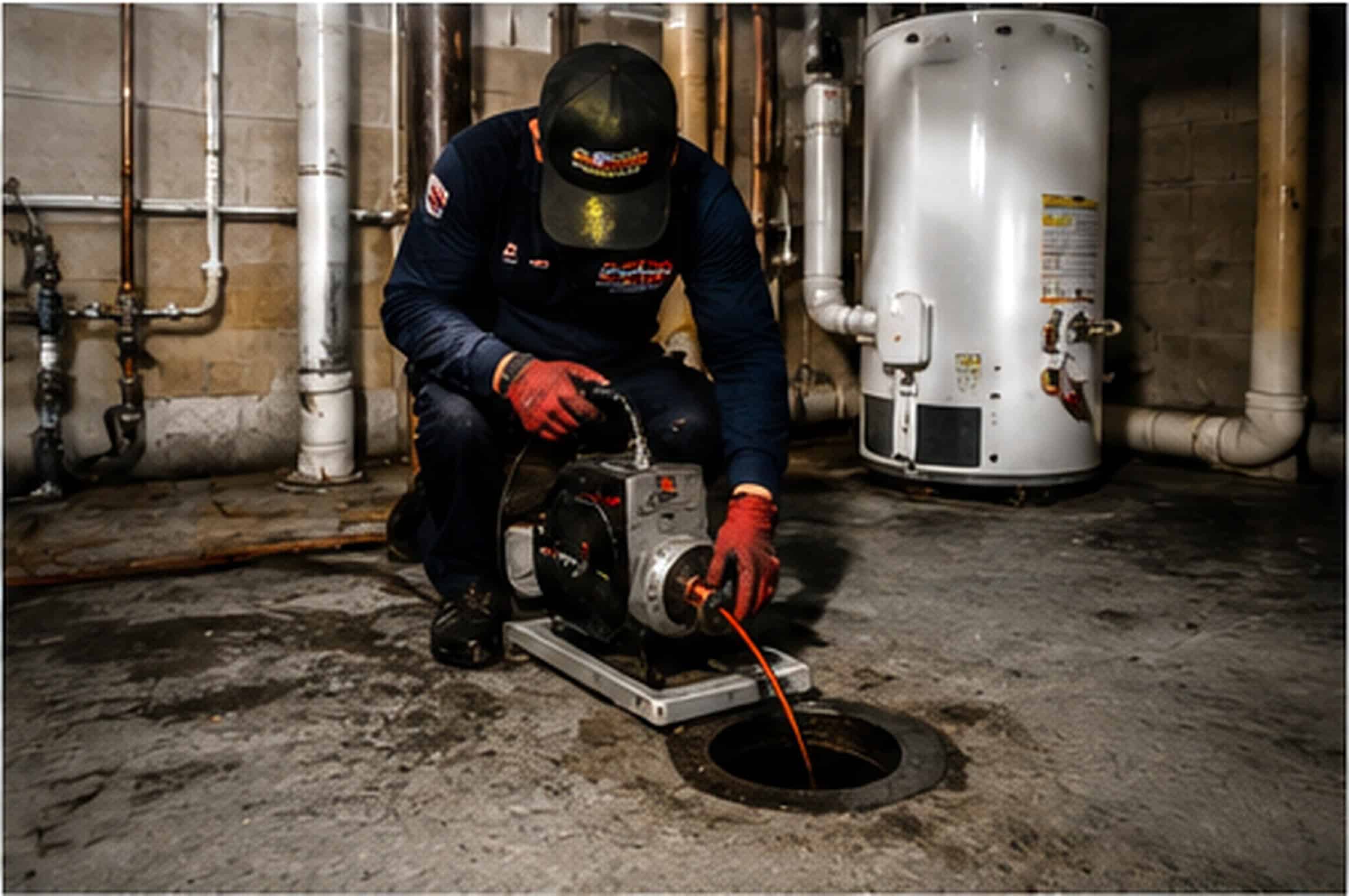
A sewer scope inspection uses a flexible push camera — typically mounted on a rod with LED lighting — to visually inspect the inside of a sewer pipe. The camera feeds live footage to a monitor so we can see what’s happening in real time. It’s the most common entry-level inspection method, and it works well for residential sewer laterals and smaller branch lines down to about two inches in diameter.
What it tells you: whether there’s visible buildup, root intrusion, standing water, or obvious damage. What it doesn’t tell you on its own: exactly where that problem is located underground, or how deep you’d need to dig to reach it.
For most residential situations in Cook County, a sewer scope is a reasonable starting point — particularly when you’re trying to answer a simple question, like whether your line has root intrusion after a slow drain, or whether a recently rodded line actually has structural damage underneath the cleared blockage.
It’s also the go-to tool for pre-purchase inspections. If you’re buying a home in Beverly, Oak Park, Evanston, or anywhere along the Southwest Side bungalow belt, a sewer scope before closing can reveal problems a standard home inspection will never catch. Home inspectors don’t go inside your sewer line. We do. For older homes — and a large share of Cook County’s housing stock was built before 1950 — that matters. Clay tile laterals installed 70 or 80 years ago weren’t designed to last forever, and a scope will show you exactly what condition they’re in before you take ownership.
One important caveat: a sewer scope run through a completely flooded or blocked line isn’t a true inspection. If the pipe is full of water or debris, the camera shows the obstruction, not the pipe walls. Quality inspection protocol clears the line first — through rodding or a light jetting pass — and then re-inserts the camera. If a provider skips that step, the footage they hand you isn’t worth much.
What you should receive at the end of a proper scope inspection: recorded video of the line’s interior, a written summary of what was found, and a clear explanation of what it means for your next steps. A verbal “looks fine” with no documentation isn’t a sewer scope inspection — it’s a sales call.
Here’s the honest limitation of a scope-only inspection: it shows you what’s happening inside the pipe, but it can’t tell you where that problem sits in relation to the surface above it. If the camera finds a crack or a root mass 40 feet into your line, you know there’s a problem — but not whether it’s under your driveway, your yard, or your neighbor’s property line. That distinction matters enormously when it comes to repair planning.
This is where homeowners in Cook County sometimes end up in a frustrating position. A contractor runs a scope, sees damage, and quotes a full sewer line replacement — because without knowing the precise location and depth of the problem, they can’t confidently propose a targeted repair. Some contractors are being honest when they do this. Others aren’t. Either way, the homeowner ends up with a quote for $10,000 worth of excavation when the actual damage might be a two-foot section of pipe at four feet depth.
That gap — between “there’s a problem” and “here’s exactly where to fix it” — is what separates a sewer scope from a sewer camera inspection with a locator. For Chicago-area homes with mature elms and oaks whose root systems have had decades to grow toward moisture, or for homes in neighborhoods like Berwyn and Cicero where the original clay tile laterals are well past their design lifespan, having that precision matters. It’s the difference between a repair estimate you can trust and one you have no way to verify.
A sewer camera inspection with a locator is what takes the process from visual documentation to actionable data. The camera component works the same way as a scope — it travels through the line and shows you what’s inside. The locator component is what changes everything.
The locator uses electromagnetic signals to track the camera’s exact position underground. As the camera moves through the pipe, we can walk the surface above and pinpoint the camera’s location and depth at any point. That means when we find a problem, we can mark the ground directly above it and tell you: the offset is here, at this depth. That’s the information a repair crew needs to dig in the right place.
Without a locator, a contractor’s repair estimate is based on what the camera shows plus their best judgment about where the pipe runs. That’s not always wrong — experienced technicians develop good instincts about pipe routing — but it introduces uncertainty that tends to resolve in favor of more excavation, not less.
With a locator, the guesswork disappears. We can tell you the root intrusion is 23 feet from your foundation at 4.5 feet depth. That’s not an approximation. That’s a coordinate. A repair crew can dig exactly there, address exactly that section, and leave the rest of the line alone.
For Cook County homeowners, this has a direct financial consequence. Chicago’s older neighborhoods — the bungalow corridors on the Southwest and Northwest Sides, the two-flat blocks in Pilsen and Brighton Park, the postwar ranches in the south suburbs — are full of homes where the sewer lateral runs under a concrete driveway, a gangway, or a finished basement floor. The cost difference between digging up a two-foot section versus a thirty-foot trench is substantial. The locator is what makes the smaller repair possible.
The sewer camera and locator combination is also what gives you documentation you can actually use. If you’re getting multiple repair bids, you can hand each contractor the same precise location data and compare apples to apples. If the problem recurs, you have a baseline record. If you’re selling the home, you have proof of what was inspected and when. That’s a fundamentally different product than a video of your pipe with no surface reference points.
Cook County’s ground conditions aren’t forgiving on sewer lines. Chicago sits on a mix of clay-heavy soils that shift with moisture changes, and the freeze-thaw cycle the region experiences every winter puts stress on pipe joints in ways that homeowners in milder climates simply don’t face. A clay tile lateral that was laid in 1940 has been through roughly 80 winters of soil movement. The joints that were tight when they were installed have shifted. Some have cracked. Some have separated just enough to let roots in.
The problem is that this kind of gradual deterioration doesn’t announce itself. A line can be losing structural integrity for years before it backs up. When it does fail — often during a heavy spring rain when the combined sewer system is already stressed — it fails completely, and the repair is no longer a targeted fix. It’s an emergency.
We’ve been inspecting sewer lines in Cook County since 2000, and we’ve seen this pattern enough times to say plainly: the homes most at risk are the ones with original clay tile or cast iron laterals, large trees in the yard, and no inspection history. That describes a significant portion of Chicago’s South Side, the inner-ring suburbs, and neighborhoods like Evanston, Harvey, and Orland Park where the housing stock is old and the tree canopy is mature.
When we run a sewer camera and locator through one of these lines, we’re not just looking for an obvious blockage. We’re looking at pipe material condition, joint integrity, the presence of root tendrils that haven’t caused a backup yet but will, and any settlement or offset that’s been developing quietly. The locator data turns those findings into a repair plan — not a guess.
If you’re dealing with a slow drain and want a basic answer, a sewer scope inspection is a reasonable place to start — provided the line is cleared first and you receive actual video documentation at the end. If you’ve already had a backup, you’re in an older Cook County home, or you’ve been quoted a repair and you want to know whether that quote is accurate, you need a sewer camera inspection with a locator. The locator is what turns a visual finding into a precise, verifiable repair location.
The short version: a scope tells you there’s a problem. A camera with a locator tells you exactly where to fix it.
If you’re not sure which one applies to your situation, that’s a conversation worth having before anyone runs a camera through your line. All Rooter Hydro Jetting Experts Inc has been doing this work in Cook County since 2000, and we’re straightforward about what each inspection delivers and what it costs. Reach out by phone or text — we’re available around the clock — and we’ll help you figure out the right next step.
Article details:
Share:
Continue learning: