From rising water bills to musty smells you can't explain, hidden leaks are sneaky. Here's how to find them — and what to do next.
Share:

Summary:
If your water bill has crept up for no obvious reason, or you’ve noticed a damp patch on a wall that shouldn’t be wet, you’re not imagining things. Hidden leaks are one of the most common — and most misdiagnosed — plumbing problems in Cook County homes. The trouble is, by the time you can see the damage, it’s usually been building for weeks.
This guide covers everything Cook County homeowners need to know about water leak detection: the warning signs, how professional detection actually works, what a sewer camera inspection involves, and what to expect from the repair side. No fluff — just the information you need to make a smart decision.
Leak detection isn’t a plumber poking around until something looks wet. Modern plumbing leak detection uses a layered approach — acoustic listening equipment, thermal imaging cameras, and infrared scanning — to locate leaks without opening walls or breaking concrete. The goal is to find the exact source before anything gets touched.
The process typically starts with a conversation. You describe what you’ve noticed — higher bills, a musty smell, wet spots, or the sound of water running when nothing’s on. From there, our technician uses electronic listening devices to pick up the pressure changes and moisture patterns that a hidden leak creates. Thermal imaging then confirms what the acoustic scan suggests, showing temperature differences in walls and floors that indicate moisture behind the surface.
What you end up with is a precise location, not a guess. That matters because unnecessary demolition — tearing out drywall, cutting into concrete — adds cost and time to any repair. Getting the location right the first time changes everything.
Cook County homeowners deal with something most of the country doesn’t: a freeze-thaw cycle that puts serious stress on plumbing year after year. Chicago’s January average lows sit around 16 to 18 degrees Fahrenheit, and the region regularly cycles through multiple freeze and thaw events in a single winter. Every time water freezes inside a pipe, it expands. Every time it thaws, that pressure releases. Over years, that cycle quietly cracks pipe joints, shifts underground lines, and creates the conditions for hidden leaks that don’t show up until spring — sometimes long after the damage has already spread.
This is especially true in older Cook County neighborhoods where the housing stock dates back to the early 1900s. Homes in Bridgeport, Pilsen, Archer Heights, and Chicago Lawn often still have cast iron or clay tile sewer lines that were never designed to handle decades of freeze-thaw stress. These materials crack, shift, and allow root intrusion in ways that modern PVC pipe doesn’t. A leak that starts as a hairline crack in January can become a significant structural problem by March.
The other factor is soil movement. Chicago’s ground heaves and contracts with temperature swings, and underground pipes move with it. Over time, that movement causes pipe bellies — sections where the pipe sags and water pools instead of draining — and joint separations that let groundwater in and sewage out. Neither of these problems is visible from inside the house. The only reliable way to find them is with a camera inside the pipe.
This is why we see a predictable surge in calls every late winter and early spring. Homeowners notice the results of a season’s worth of freeze-thaw damage all at once: slow drains, wet spots, high bills, and backups that weren’t there in October. If you’re experiencing any of those symptoms after a Cook County winter, a plumbing inspection isn’t overcautious — it’s the right call.
A sewer line camera inspection is exactly what it sounds like: a small, waterproof camera fed through your drain or sewer line to show you what’s happening inside the pipe. But the value of a sewer camera inspection isn’t just in finding problems — it’s in showing you the evidence directly, so you’re not relying on a verbal summary from someone you just met.
At All Rooter Hydro Jetting Experts Inc., every sewer camera inspection produces a complete video recording of the pipe system. You get the actual footage. Problem areas are marked by distance from the entry point, so the location is specific and verifiable — any contractor can find the exact spot without guessing. A written report accompanies the recording, documenting what was found and where.
What does the camera typically find in Cook County homes? The most common findings are tree root intrusion (the region’s mature urban canopy is beautiful, but the roots go looking for water), cracked or collapsed pipe sections, pipe bellies where water pools, joint separations, and grease or debris buildup that’s narrowed the pipe to the point of near-blockage. In older Cook County homes, it’s not unusual to find sections of clay tile or Orangeburg pipe — materials that were standard 70 years ago but are well past their service life today.
The camera also helps answer a question that matters a lot in Cook County: is the problem on your property, or is it in the city’s section of the sewer line? In Chicago and Cook County, you’re responsible for the sewer lateral from your home to the city main. If the damage is on your side of that line, repair falls to you. If it’s past the property line, it’s the city’s responsibility. A sewer camera inspection with a locator — a radio frequency tool that pinpoints the camera’s position above ground — tells you exactly where the problem is relative to your property line. That information can save you from paying for a repair that the city should be handling.
If you’ve never had a sewer camera inspection, it’s natural to wonder what you’re actually signing up for. The short version: it’s non-invasive, it takes a couple of hours at most, and it gives you a clear picture of your sewer system’s condition without anyone digging up your yard or opening your walls.
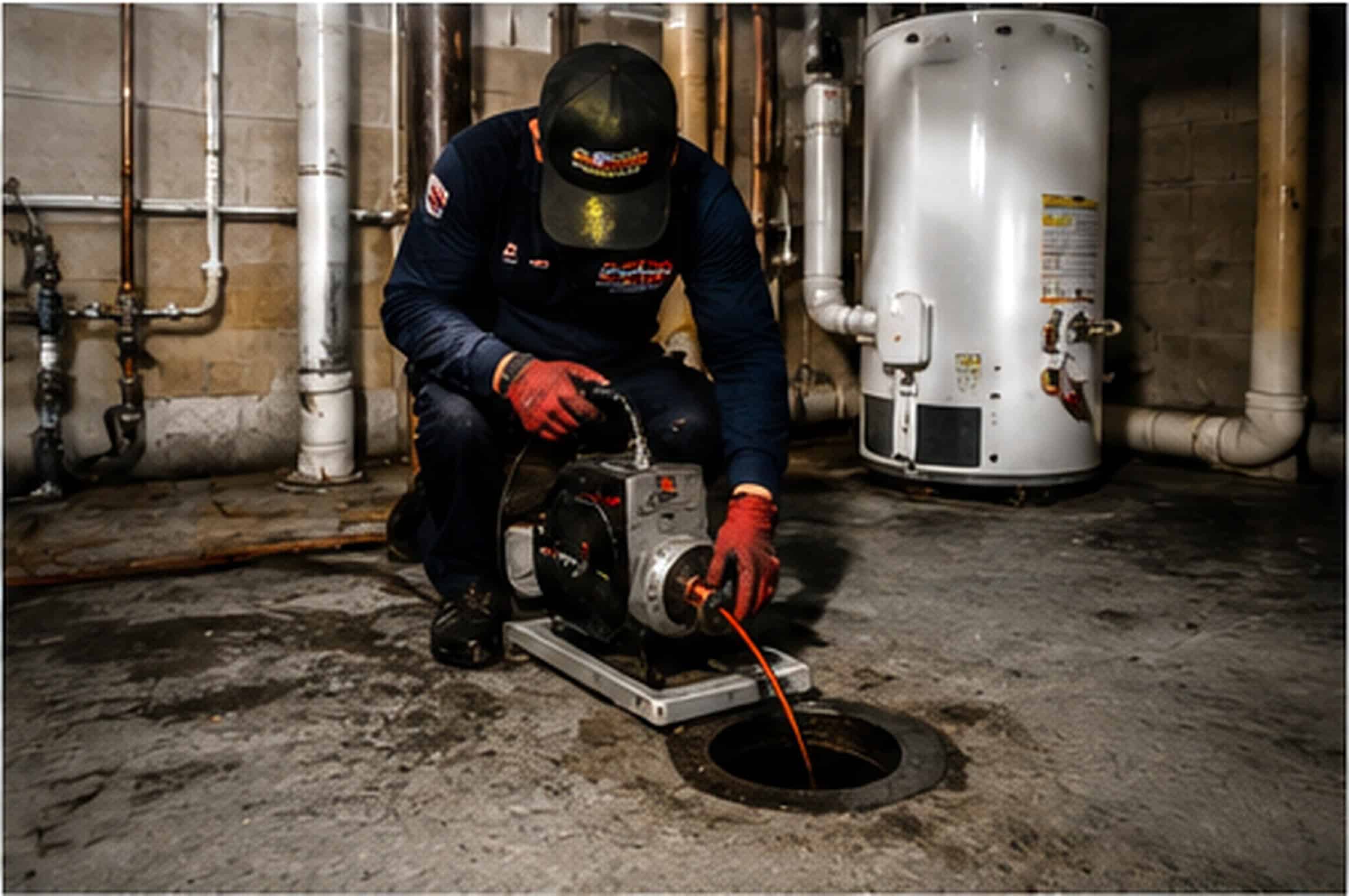
Our technician accesses the sewer line through a cleanout — a capped pipe that provides direct access to the sewer lateral — or through a drain opening if no cleanout is present. The camera travels through the pipe while we monitor the live feed. When something worth noting appears, it gets documented with footage and a distance measurement. At the end, you have a full recording and a written report explaining what was found.
The cost for a professional sewer camera inspection in Cook County typically runs between $175 and $500, depending on the scope of the inspection and what’s involved in accessing the line.
These terms get used interchangeably, but they’re not quite the same thing. A drain video inspection typically focuses on a specific drain line — a kitchen drain, a floor drain, a laundry line — to diagnose a localized problem. A full sewer pipe inspection covers the main sewer lateral from the house to the city connection, which is a longer run and a more comprehensive look at the system as a whole.
Which one you need depends on where the symptoms are showing up. If one drain in your home is slow and the others are fine, a drain line camera inspection of that specific line is usually the right starting point. If multiple drains are slow, you’re hearing gurgling sounds from different parts of the house, or you’ve had a sewage backup, the problem is more likely in the main line — and a full sewer scope inspection is the appropriate tool.
Cook County homes with older plumbing systems often benefit from a full plumbing scope inspection that covers both the supply side (water lines coming in) and the drain/sewer side (waste lines going out). These are separate systems with separate failure modes. A camera inspection of the sewer line won’t detect a pinhole leak in a copper supply line behind a wall — that requires the acoustic and thermal imaging approach described earlier. A comprehensive plumbing pipe inspection looks at both, which is why it’s the more thorough option when you’re buying a home or haven’t had a professional assessment in years.
CCTV inspection services — closed-circuit television, which is what the camera system is technically called — are now the industry standard for sewer and drain diagnosis. We always recommend a camera inspection as the first step before recommending repairs, not as an add-on after the fact. If someone quotes you a repair without first putting a camera in the line, that’s worth questioning.
Most conversations about sewer camera inspections focus on the main sanitary sewer line, but there are two other systems worth knowing about: storm drains and septic systems.
Chicago and Cook County operate a combined sewer system in many older areas, meaning storm water and sanitary sewage share the same underground lines. During heavy rainfall — and Cook County gets its share of significant storm events — that system can surcharge, pushing water back up through floor drains and basement fixtures. A storm drain camera inspection can identify blockages, damage, or capacity issues in the storm drain portion of your system before the next major rain event turns your basement into a problem. If you’ve had basement flooding during heavy rain, this is a logical diagnostic step.
For properties in the outer Cook County suburbs or unincorporated areas that aren’t connected to municipal sewer, a septic camera inspection serves a similar purpose. A septic system camera inspection runs a camera through the inlet and outlet lines of the tank and into the distribution system to check for blockages, root intrusion, or pipe damage. Septic systems that haven’t been inspected in several years are operating on borrowed time — and a camera inspection is far less disruptive than discovering a failure through a sewage backup.
Both storm drain camera inspection and septic camera inspection are services we offer as part of our broader drain inspection services. If you’re not sure which type of inspection applies to your property, describing your symptoms and your property’s setup is usually enough to point us in the right direction.
If your water bill has gone up without explanation, you’re smelling something musty in a space that should be dry, or you’ve had a drain backup that cleared on its own and you’re not sure why — those are all reasons to get a professional set of eyes on your plumbing system. Hidden leaks and sewer problems rarely resolve themselves. They tend to get worse slowly, then suddenly.
The good news is that professional water leak detection and sewer camera inspection are non-invasive, relatively fast, and give you real information — not guesswork. You see what we see. You get the footage and the written report. You know exactly what’s wrong and where before any repair conversation starts.
All Rooter Hydro Jetting Experts Inc. has been serving Chicago and Cook County since 2000. If you’re ready to find out what’s actually going on with your plumbing, reach out. We offer free estimates, upfront pricing, and 24/7 availability for situations that can’t wait.
Article details:
Share:
Continue learning: