Your tankless water heater works overtime in Chicago's hard water. Regular cleaning prevents efficiency loss, protects your warranty, and extends system life.
Share:

Summary:
Your tankless water heater seemed like the perfect upgrade. Endless hot water, better efficiency, more space. Then Chicago’s hard water started doing what it does best—leaving its mark. Maybe you’ve noticed the water taking longer to heat up, or the temperature isn’t as consistent as it used to be. Those aren’t quirks. They’re symptoms of mineral buildup quietly choking your system.
Here’s what you need to know about keeping your tankless water heater clean in one of the hardest water regions in the country, and why the maintenance schedule you thought you signed up for might not cut it here.
Chicago pulls its water from Lake Michigan, and while that’s generally good news, it comes with a catch. The water here tests between 130 and 150 parts per million for hardness—that’s 7.6 to 8.8 grains per gallon. Officially, that’s classified as “hard.” Some areas in Cook County push even higher, hitting 181 to 250 mg/L.
What does that mean for your tankless water heater? Calcium and magnesium. Lots of it. Every time water flows through your heat exchanger, trace amounts of these minerals get left behind. Over weeks and months, those traces become deposits. Those deposits become scale. And that scale becomes a problem that affects everything from efficiency to lifespan.
The reality is that tankless water heater cleaning isn’t optional in Chicago—it’s essential maintenance that directly impacts how long your system lasts and how well it performs.
Your tankless system works by flash-heating water as it moves through narrow copper or stainless steel tubes inside the heat exchanger. It’s efficient. It’s compact. And it’s exactly the kind of environment where mineral scale loves to form.
When water heats up quickly, calcium and magnesium separate out and stick to the metal surfaces. Think of it like the white crust that builds up around your faucet, except it’s happening inside the most critical component of your water heater. Just 1/8 inch of scale can reduce your system’s efficiency by 30%. Let it go longer, and you’re looking at a 48% drop.
That’s not just a performance issue. It’s a cost issue. Your system has to work harder to heat the same amount of water, which means higher energy bills. The added strain also wears down components faster, shortening what should be a 20-year lifespan down to 12 years or less.
And here’s the part that stings: most manufacturers consider scale buildup a maintenance issue, not a defect. If your heat exchanger fails because it’s clogged with calcium, your warranty likely won’t cover it. You’ll be on the hook for a repair that can run anywhere from $600 to over $1,300, or a full replacement that costs $2,500 to $4,500.
Chicago’s hard water accelerates all of this. What might take 18 months to develop in a soft water area can happen in 6 to 8 months here. That’s why the “annual maintenance” recommendation you see in most manuals doesn’t quite match what your system actually needs in Cook County. Regular tankless water heater cleaning becomes twice as important when you’re dealing with water this mineral-rich.
Your system will tell you when mineral buildup is becoming a problem. You just have to know what to listen for.
Reduced water flow is usually the first sign. If your shower pressure isn’t what it used to be, or it takes longer to fill the tub, scale is likely narrowing the pathways inside your heat exchanger. Temperature fluctuations come next—hot water that suddenly goes lukewarm mid-shower, or what people call the “cold water sandwich” where a burst of cold interrupts your hot water flow.
Strange noises are another red flag. Rumbling, clanging, or a sound like popping or kettling means water is getting trapped behind scale deposits and turning into steam bubbles that burst violently. If you’re seeing error codes on your display, especially ones related to flow or temperature sensors, mineral buildup is often the culprit.
Some homeowners notice white or greenish buildup around pipe connections or valves. That’s mineral deposits making their way to the outside, which means the inside is worse. And if your energy bills have crept up without any other explanation, your system is likely working overtime to push heat through layers of scale.
None of these issues fix themselves. Scale doesn’t dissolve on its own. It accumulates. And the longer you wait, the more damage it does—not just to efficiency, but to the components themselves. Sensors get fouled. Valves get stuck. The heat exchanger degrades. What starts as a tankless water heater cleaning issue becomes a repair issue, and eventually a replacement issue.
Cleaning a tankless water heater isn’t like draining a traditional tank. There’s no sediment sitting at the bottom waiting to be flushed out. Instead, you’re dealing with mineral scale bonded to the interior surfaces of your heat exchanger. That requires a different approach.
The process is called descaling, and it involves circulating a cleaning solution through your system to dissolve and remove calcium and magnesium deposits. Professional service typically takes 45 to 60 minutes of active circulation time, plus setup and flushing. It’s the most effective method for restoring your system to proper working condition.
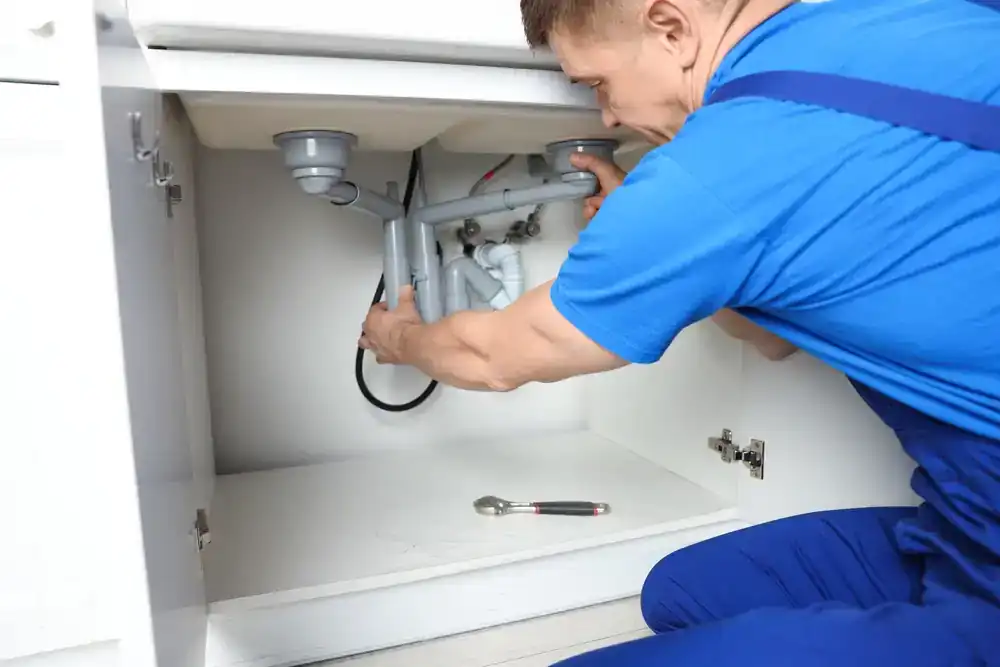
Here’s what happens when we service your tankless water heater. First, we shut off the power source—gas or electric—and close the three water valves: cold water in, hot water out, and the main supply. This isolates the system so cleaning solution can circulate without flowing into your home’s plumbing.
Next, we remove the purge port valve caps. There’s usually some pressure built up, which is why it’s important to confirm everything is shut off correctly. Hoses get attached to the cold and hot water service ports, connected to a circulation pump sitting in a bucket.
The bucket holds the descaling solution—either a commercial product designed for tankless systems or white vinegar for a more eco-friendly option. Commercial descalers work faster and more aggressively on heavy buildup. Vinegar works too, but needs more time (60 to 90 minutes instead of 45).
Once everything’s connected, the pump runs, pushing the solution through the heat exchanger over and over. That’s where the actual cleaning happens. The acidic solution breaks down the mineral deposits, pulling them off the metal surfaces and carrying them out through the hoses back into the bucket. This is the heart of the flushing tankless water heater process—circulation that reaches every part of the heat exchanger.
After the circulation time is up, the system gets flushed with clean water to remove any remaining solution and loosened debris. Hoses come off, caps go back on, valves reopen. Power and gas get restored. Then it’s a matter of running hot water at a few faucets to clear any air from the lines and confirm everything’s flowing properly.
But a good service call doesn’t stop at descaling. We also clean the inlet filter screen—a small mesh that catches debris before it reaches the heat exchanger. We test the pressure relief valve to make sure it’s not stuck or leaking. We inspect venting to confirm there’s no blockage or backdraft. And we check for any signs of leaks, corrosion, or worn components that might need attention soon.
That’s the difference between a thorough service and just running some vinegar through the system. You’re not just getting cleaning. You’re getting early problem detection, before issues turn into expensive failures. This comprehensive approach to flushing tankless water heater systems is what separates professional service from DIY shortcuts.
Can you flush your tankless water heater yourself? Technically, yes. Is it the right call for everyone? Not necessarily.
DIY descaling requires some equipment: a submersible pump (around $40 to $60), two hoses with the right fittings, a bucket, and either white vinegar or a commercial descaling solution. One-time cost runs $100 to $300 for a complete kit, and it’s reusable. If you’re comfortable with basic plumbing tasks, confident following step-by-step instructions, and willing to spend an hour or two on the process, it’s doable.
But here’s where it gets tricky in Chicago. Our hard water creates more aggressive buildup than most DIY guides account for. Vinegar might not cut through heavy scale as effectively as commercial products. And if you miss a step—don’t flush long enough, don’t clean the inlet filter, don’t test the pressure valve—you might think you’ve solved the problem when you’ve only addressed part of it.
There’s also the warranty consideration. Most manufacturers require documented professional maintenance to keep coverage valid. If your heat exchanger fails in year seven and you can’t prove it was serviced annually by a licensed plumber, you might be paying out of pocket for a repair that should have been covered. That’s a $2,000+ risk to save $150 on a service call. The warranty protection alone makes professional tankless water heater cleaning worth considering.
Professional service costs $150 to $350 in the Chicago area, depending on the company and what’s included. Yes, that’s more than DIY. But you’re also getting a trained eye on your system—someone who can spot a failing component before it leaves you without hot water, who knows what “normal” looks like for your specific model, and who provides documentation that protects your warranty.
For homeowners who’ve never done it before, or who aren’t sure their system was maintained properly by previous owners, professional service makes sense. For those who are hands-on, have the right tools, and are willing to accept the warranty risk, DIY can work—but only if it’s done correctly and consistently. In Cook County, where hard water doesn’t give you much margin for error, professional service is usually the smarter play.
Manufacturer manuals typically recommend annual descaling. That’s fine for soft water regions. In Chicago, it’s not enough.
With water hardness in the 7 to 8 grains per gallon range, most tankless systems need descaling every 6 to 8 months to prevent performance issues and component damage. If your area pushes into the “very hard” category above 10 grains per gallon, you’re looking at service every 4 to 6 months. This accelerated schedule for descaling tankless water heater systems isn’t about upselling—it’s about protecting equipment from conditions that cause faster-than-normal wear.
That might sound excessive. It’s not. It’s what your system needs to maintain efficiency, protect your warranty, and reach its full 20-year lifespan. Think of it like oil changes for your car—you could stretch it out and hope for the best, or you could follow the schedule that actually protects your investment.
The cost of regular maintenance is small compared to the cost of neglect. A $150 to $350 service call twice a year is $300 to $700 annually. A single repair averages $600. A replacement costs thousands. And every month your system runs with scale buildup, you’re paying more on your energy bill than you should be. Regular descaling tankless water heater service pays for itself through lower energy costs, fewer repairs, and extended equipment life.
If you’re dealing with inconsistent hot water, strange noises, error codes, or reduced flow, don’t wait for your next scheduled service. Those are signs your system needs attention now. The longer mineral deposits sit, the harder they become to remove and the more damage they cause.
Article details:
Share:
Continue learning: