
Discover the critical first steps for frozen pipe repair in Cook County — what to do, what to avoid, and when to call a professional.
Share:
Summary:
You turned on the faucet and nothing came out. Maybe a trickle, maybe dead silence. Your first instinct might be to panic — or to grab a hair dryer and start hunting for the problem. Before you do either, take a breath. A frozen pipe that hasn’t burst yet is still a manageable situation. What happens in the next 10 to 15 minutes, though, matters more than most people realize. This guide covers exactly what to do first, what to absolutely avoid, and how to know when it’s time to stop troubleshooting and call us.
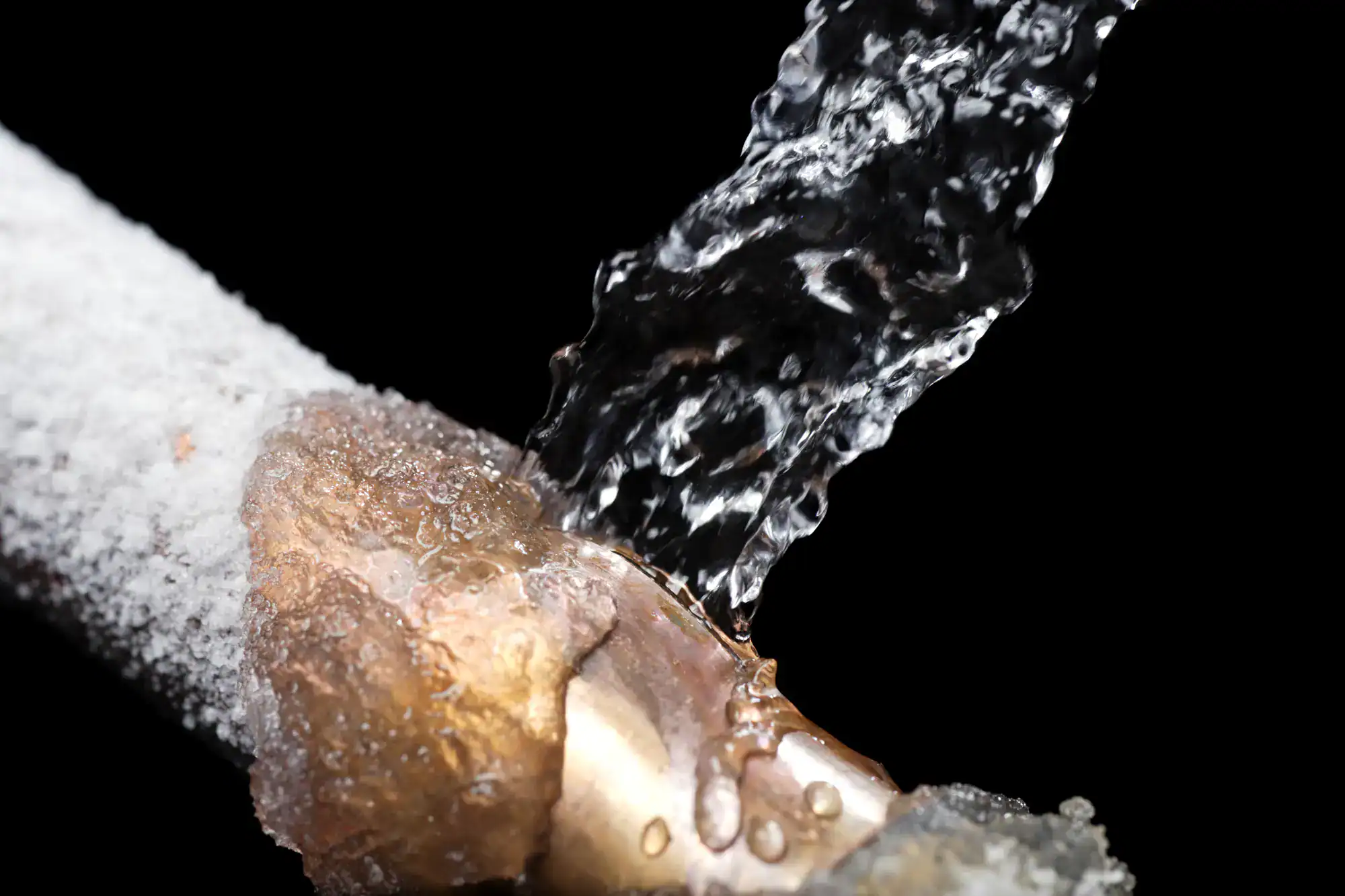
When water freezes inside a pipe, it expands. That expansion puts enormous pressure on the pipe wall from the inside — pressure that has nowhere to go. The pipe doesn’t always burst at the freeze point itself. It often fails somewhere else entirely, at a joint, a fitting, or a section that was already weakened by years of corrosion.
This is especially common in Cook County’s older housing stock, where galvanized steel supply lines and cast iron drain systems have been accumulating internal corrosion for decades. Many homes in Archer Heights, Brighton Park, and Cicero were built between 1910 and 1940 with pipe routing that no modern code would permit.
The freeze doesn’t announce itself loudly. No water at the faucet, a faint frost on an exposed section of pipe, or a strange gurgling sound when you run water elsewhere in the house — these are the quiet signals that something is wrong. The danger is that by the time you notice, pressure may already be building toward a failure point you can’t see.

The single most important thing you can do before anything else is locate your main water shut-off valve and know how to close it. In most Cook County bungalows and two-flats, it’s in the basement — often near the front of the house, close to where the main water line enters from the street. In some older homes, it may be inside a utility closet or near the water meter. If you’ve never found it, now is the time. You don’t necessarily need to shut it off immediately, but you need to know where it is in case the pipe bursts while you’re working.
Once you’ve located the shut-off, open the faucet connected to the frozen pipe. Leave it open. This does two things: it relieves pressure that’s building up behind the ice, and it gives you a clear signal — running water — when the pipe starts to thaw. Even a slow drip means pressure is releasing, which is a good sign.
Next, assess what you can actually see. Is the frozen section accessible — an exposed pipe under a sink, along a basement wall, or in a crawl space? Or is the freeze somewhere inside a wall or ceiling? This distinction matters enormously. If you can see and touch the pipe, you have options. If the freeze is hidden, a hair dryer isn’t going to help you, and attempting to guess your way through it can make things worse.
If the pipe is accessible, you can apply gentle, controlled heat — a hair dryer on low, a heating pad wrapped around the pipe, or warm towels. Start at the faucet end and work back toward the blockage. Never start at the blockage itself and heat toward the faucet; you can trap steam pressure between the ice and the heat source, which increases the risk of a rupture. Keep the faucet open the entire time.
What you should not do is reach for anything with an open flame. No propane torch, no lighter, no candles near the pipe. Open flames are a fire hazard in any setting, but in the enclosed spaces where frozen pipes typically occur — inside walls, in crawl spaces, near insulation — they can ignite structural materials before you realize anything is wrong. This is one of the most common causes of house fires associated with frozen pipe attempts.
This is the question most homeowners don’t think to ask until it’s too late. A pipe can burst and you won’t always know it right away — especially if the break is inside a wall or in an area you can’t see directly. The water may not appear immediately. It can pool slowly inside a wall cavity, seep into insulation, or run along a floor joist before it becomes visible. By the time you see water, the damage has already started.
There are signs to watch for before you begin any thawing attempt. If you see visible water staining, swelling drywall, or wet spots on the ceiling or floor near where you suspect the freeze is, stop. Shut off the main water valve before you do anything else. Applying heat to a pipe that has already burst — with the water supply still on — will release water into your home the moment the ice melts. A rupture as small as one-eighth of an inch can release up to 250 gallons of water per day. In a Cook County two-flat or three-flat, that water doesn’t just affect one unit.
If you shut off the water and the wet spots stop spreading, you’ve confirmed a burst. At that point, you’re no longer dealing with a frozen pipe problem — you’re dealing with a burst pipe repair, and that requires a licensed plumber. Attempting to patch a burst pipe yourself without understanding the full extent of the damage, or without the right materials for the pipe type, is a temporary fix at best and a code violation at worst.
Even if the pipe hasn’t burst, a pipe that has survived a freeze is not necessarily undamaged. Micro-fractures can form during the freeze cycle that aren’t visible to the eye and don’t cause immediate failure. They show up during the next cold snap, or the one after that. This is why post-thaw inspection matters — and why “it thawed fine” isn’t the same as “it’s fine.”
There’s a point in every frozen pipe situation where DIY stops being the right call. It’s not a failure to admit that — it’s just an accurate read of the situation. If the freeze is inside a wall, under a concrete slab, or in a crawl space you can’t safely access, professional equipment is the only realistic option. Our electrical pipe thawing machines restore flow from the inside out and can reach sections that no heat gun or hair dryer ever could.
Cook County’s housing stock makes this more common than people expect. Homes in Archer Heights, Bridgeport, Cicero, and Berwyn were built with pipe routing that no modern code would permit — through unheated attic spaces, along exterior walls without insulation, and into crawl spaces that see temperatures close to outside air during a polar vortex. These aren’t hypothetical vulnerabilities. They’re the reality of living in some of the most architecturally distinct and historically rich housing in the Midwest.

Our frozen pipe repair doesn’t start with heat. It starts with diagnosis. Before anything is thawed, we locate the frozen section — using professional tools, not guesswork — and assess whether the pipe has already failed. If there’s a burst, the water supply gets shut off before any thawing begins. This step alone is what separates a controlled repair from a flood.
Once the freeze point is confirmed and the pipe is assessed as intact, thawing begins using equipment designed for the task. Our electrical pipe thawing machines apply controlled heat through the pipe itself, working efficiently even on pipes buried inside walls or under floors. The process is methodical and it works from the accessible end toward the blockage — the same direction you’d use with a hair dryer, but with far more precision and reach.
After the pipe is thawed and flow is restored, the work isn’t done. We conduct a thorough inspection to check for micro-fractures, weakened joints, and any sections that show signs of corrosion or thinning from the freeze. In Cook County homes with galvanized steel supply lines — common in anything built before 1960 — this inspection matters more than it does in a newer home. Galvanized pipe corrodes from the inside over time, reducing wall thickness and making it more vulnerable to freeze-related cracking. What looks fine on the outside may not be fine on the inside.
We’ve been doing this work in Cook County since 2000. That’s over 25 years of Chicago winters, including the polar vortex events of 2019 and 2021 when temperatures in the city dropped to -20°F and frozen pipe calls came in around the clock. We know where the freeze points tend to be in a pre-war bungalow. We know the difference between a galvanized line that’s been compromised and one that’s still solid. And we know that showing up fast, quoting the price before we start, and doing the job right the first time is what keeps people calling us back.
There’s a reason frozen pipe calls in Cook County tend to be more complicated than in newer suburban construction. The bungalow belt that runs through Archer Heights, Brighton Park, McKinley Park, and out into Cicero and Berwyn represents tens of thousands of homes built when pipe insulation standards were essentially nonexistent. Pipes were routed wherever they fit — through unheated exterior walls, across attic floors, and into crawl spaces that offer no thermal protection whatsoever.
When temperatures drop below 20°F and stay there for three or four days, these homes don’t just get cold. The pipes inside them get cold in ways that modern construction largely prevents. Lake Michigan makes this worse for communities on the eastern edge of Cook County. In Evanston, Hyde Park, and Rogers Park, wind chill off the lake can drive the effective temperature well below what the thermometer reads — and sandy lakefront soils allow frost to penetrate deeper than in other parts of the county.
A pipe that survived last winter without incident may not survive this one if conditions are more sustained or more severe. After a freeze event, the most important thing you can do is not assume everything is fine because nothing burst. Have the affected pipes inspected. Identify where the freeze occurred and why — was it an uninsulated exterior wall? A pipe routed through an unheated space? A section of galvanized line that’s been thinning for years? These are the questions that prevent the same emergency from happening again next January.
One service that’s rarely discussed in this context is hydro jetting. When pipes have been weakened by a freeze, they often have accumulated sediment, scale, or debris that compounds the vulnerability. Post-thaw hydro jetting clears that buildup and restores full flow capacity — something a standard thaw alone doesn’t address. We can handle both the immediate repair and the follow-up service in a single visit.
If the repair turns out to be more extensive than expected, financing is available through Hearth — you can apply online before we arrive or during the visit. An emergency repair shouldn’t force you to choose between doing it right and managing your budget.
A frozen pipe is a stressful situation, but it’s a manageable one if you move quickly and make the right calls. Locate your shut-off valve, open the affected faucet, apply gentle heat only to what you can see and safely access, and watch for any signs that the pipe has already failed. If anything is uncertain — if the freeze is hidden, if you see water where it shouldn’t be, or if the pipe is older galvanized steel in a pre-war Cook County home — that’s the moment to call us rather than push further on your own.
We’re available 24/7, we quote the price before we start, and we’ve been handling frozen pipe repair across Cook County for over 25 years. When you’re ready to stop guessing and get it handled, All Rooter Hydro Jetting Experts Inc. is one call or text away at 708-669-3570.
Article details:
Share:
Continue learning:


