Been told you need a sewer repair — or worse, a full replacement? Here's how to know which one actually applies to your situation before you spend a dime.
Share:

Summary:
You’ve been told something is wrong with your sewer line. Maybe your drains are slow again after the third rodding in two years. Maybe we scoped the line and came back with a number that made your stomach drop. Maybe you just bought a house in Bridgeport, Oak Lawn, or another Cook County community and you want to know what you’re actually dealing with before you close.
Whatever brought you here, the question underneath it is the same: do I actually need a full replacement, or is repair enough? That’s what this post is for — a straight answer, grounded in what we see every day working sewer lines across Cook County.
The honest answer is that pipe age alone doesn’t tell you much. A clay tile lateral installed in 1952 in a Garfield Ridge bungalow might have one isolated root intrusion at a joint — and that’s a repair. The same pipe in a different yard might have three collapsed sections and a grade failure — and that’s a replacement.
The only way to know which situation you’re actually in is to look inside the pipe with a camera. What the footage reveals shapes everything that follows. A single crack or root intrusion in an otherwise intact pipe is a strong repair candidate. Widespread corrosion, multiple failure points, or a section that has lost its slope — that’s when replacement starts making more financial sense than patching things together.
A useful benchmark: when repair costs stay under 40% of full replacement cost, repair is generally the sound financial choice. If you’re being quoted repair costs that creep close to — or past — that threshold, it’s worth asking for a full replacement estimate in writing so you can compare them side by side.
Cook County has a specific combination of factors that puts its sewer laterals under more stress than most markets in the country — and understanding them helps you make sense of what you’re being told.
The housing stock throughout Chicago’s South Side, inner-ring suburbs like Cicero and Berwyn, and older communities across Cook County is heavily concentrated in the pre-1950 and pre-1970 range. That means a significant share of sewer laterals in these neighborhoods were installed in clay tile — a material that was perfectly adequate when new but that develops cracks at the joints as soil shifts beneath it over decades. Cast iron pipes from the same era corrode from the inside out, eventually thinning to the point of failure.
The soil makes things worse. Cook County sits on Drummer series clay-heavy soil that expands when wet and contracts when dry. Every freeze-thaw cycle — and Chicago gets extreme ones, with polar vortex events driving temperatures well below zero — causes the ground to heave and settle. That movement stresses buried pipe joints and widens existing cracks over time.
Then there are the trees. The bungalow belt neighborhoods near our base on the South Side — Archer Heights, Brighton Park, Back of the Yards, Garfield Ridge — have mature parkway oaks and elms that have been growing for 60 or 70 years. Their root systems are exactly the right size to find a hairline gap in a clay tile joint and work their way in, slowly at first, then aggressively. A root mass that takes a few years to form can block a sewer line almost completely.
None of this means your pipe is automatically beyond saving. But it does mean that if your home was built before 1970 in Cook County, the odds that your sewer lateral is showing some form of wear are genuinely high — and a camera inspection is the only honest way to find out where on that spectrum you fall.
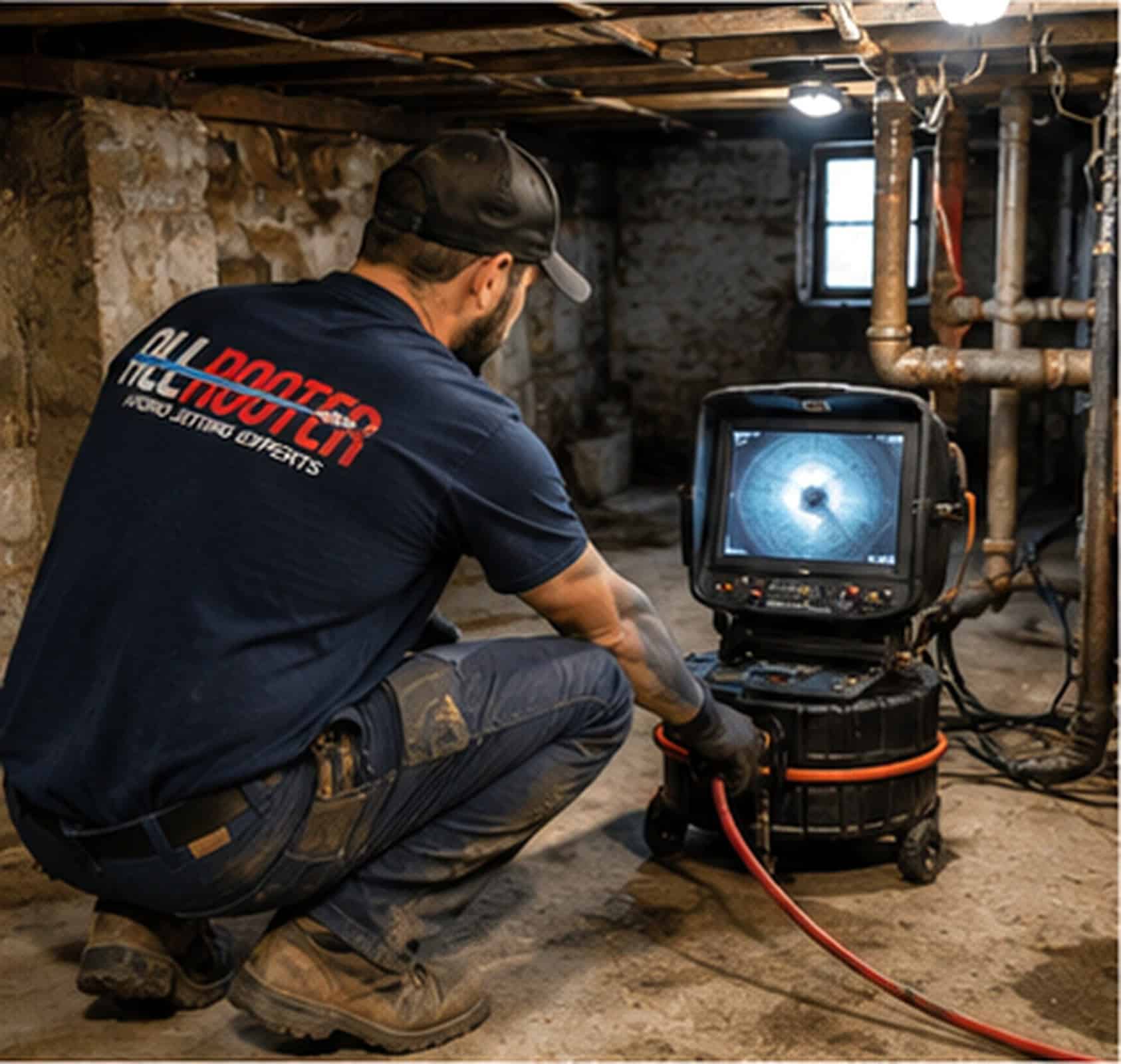
The single most important thing we can do for you is show you what’s inside your pipe before recommending a course of action. Not describe it. Show you.
When we run a camera through a sewer lateral, the footage tells a story that no surface-level assessment can replicate. You can see whether there’s one isolated problem or several. You can see whether the pipe walls are still structurally sound between the damage points. You can see whether roots have infiltrated a joint or whether a section has actually collapsed. That footage is the basis for an honest recommendation — and it’s the evidence you need to evaluate whether the quote you received is reasonable.
This matters more than most homeowners realize. The fear of being oversold from a repair to a full replacement is one of the most common anxieties in this category, and it’s not unfounded. There are real cases where homeowners received firm quotes without a full camera inspection, only to be handed a much larger invoice once work had already started. Seeing the footage yourself doesn’t require any technical expertise — a good technician will walk you through what you’re looking at. If a company isn’t willing to show you the camera footage before recommending replacement, that’s a reason to get a second opinion.
We’ve been running camera inspections as a standard part of our diagnostic process since we started doing this work in 2000. It’s not an upsell — it’s the only way to give you an honest answer. For pre-purchase sewer inspections, which are increasingly common in Cook County real estate transactions, it’s the most useful single piece of information a buyer can have before closing.
Cost is usually the first question, and it deserves a straight answer. Sewer line repairs — meaning targeted fixes to a specific section of pipe — typically run between $2,500 and $4,000. Full sewer line replacement, when the entire lateral needs to come out and be replaced, generally falls between $3,000 and $7,000, depending on the pipe’s depth, length, material, and how it’s accessed.
Partial replacements, where only a segment of the line is relayed, are typically priced at $50 to $250 per linear foot. Those ranges are wide because the variables are real. A shallow lateral in a yard with clear access is a very different job from a deep pipe running under a concrete driveway in an older Chicago neighborhood. The method used — traditional excavation versus trenchless — also affects the final number, though not always in the direction homeowners expect.
Trenchless pipe repair has become one of the most important developments in sewer work over the past two decades, and it’s particularly relevant in Cook County’s established residential neighborhoods where mature landscaping, brick driveways, and concrete sidewalks make traditional excavation enormously disruptive.
The most common trenchless method for repair is CIPP — cured-in-place pipe lining. A flexible liner saturated with resin is pulled into the existing pipe and inflated against the walls, then cured in place. The result is a new structural surface inside the old pipe, sealing cracks, blocking root entry points, and restoring flow capacity. CIPP liners are rated for 50 or more years — comparable to, and in some cases exceeding, the lifespan of new pipe installed through traditional excavation.
CIPP works well when the existing pipe is cracked or has root intrusion but is still structurally present — meaning the pipe walls haven’t collapsed entirely and the pipe’s grade (its slope toward the municipal main) is still intact. When a section has collapsed completely, or when the grade has shifted to the point where the pipe no longer drains properly, lining isn’t an option and excavation or a different trenchless method is required.
What trenchless repair costs depends on the length of pipe being lined and the access conditions. The advantage isn’t always a lower price — it’s the preservation of your yard, your driveway, and your landscaping. In neighborhoods where a mature oak has been growing over a sewer lateral for 60 years, the cost of excavating around that root system can easily exceed the cost difference between traditional and trenchless methods.
It’s worth separating two things that often get conflated: trenchless repair and trenchless replacement. They’re different methods that apply to different situations.
Pipe lining, described above, repairs the existing pipe by creating a new structural surface inside it. Pipe bursting is a trenchless method for full replacement — it threads a bursting head through the old pipe, fracturing it outward into the surrounding soil while simultaneously pulling a new pipe into place behind it. The result is a fully replaced lateral with minimal surface disruption. No open trench running the length of your yard. No torn-up driveway.
Pipe bursting is the right call when the existing pipe is too deteriorated to support a liner — complete collapse, severe corrosion throughout, or a grade failure that requires rerouting. It’s also the preferred method when the old pipe material (particularly clay tile) has degraded to the point where even a liner wouldn’t have a stable substrate to bond to.
For Cook County homeowners dealing with a 70-year-old clay lateral that’s failing in multiple places, pipe bursting often represents the best combination of permanence and minimal disruption. The new pipe going in — typically high-density polyethylene — carries a service life measured in decades, not years. Whether pipe bursting is feasible for your specific situation depends on what the camera inspection shows — which brings everything back to starting with the footage.
The right company starts with a camera, shows you the footage, and gives you both a repair estimate and a replacement estimate in writing before any work begins. We’re licensed, bonded, and insured — and we carry the contractor registration Cook County requires for sewer work. If a company is pushing you toward full replacement without showing you the pipe first, get a second opinion.
Experience with Cook County’s specific infrastructure matters more than it might seem. Clay tile, cast iron, the county’s clay-heavy soil, the freeze-thaw cycles — these aren’t generic plumbing problems. They’re the everyday reality of sewer work in this market, and a company that has been doing this work here for 25 years reads that footage differently than one that hasn’t.
If you’re working through this decision right now — whether it’s a quote you’re not sure about, a recurring backup that rodding keeps failing to fix, or a pre-purchase inspection before you close on a home — All Rooter Hydro Jetting Experts Inc. is available 24/7, offers free estimates, and will show you exactly what’s going on inside your pipe before recommending anything. Reach out by call or text and we’ll take it from there.
Article details:
Share:
Continue learning: