If your Cook County home was built before 1970, your cast iron pipes may be closer to failure than you think. Here's what's actually happening underground.
Share:
Summary:
There’s a plumbing problem hiding under a lot of Cook County homes — and most homeowners have no idea it’s there. If your house was built before 1970, there’s a good chance your drain lines are original cast iron. That pipe has been down there for 55, 60, maybe 80 years, handling everything you’ve put through it. And while cast iron is tough, it doesn’t last forever — especially not in Cook County, where the soil, the climate, and the water supply all work against it in ways that most plumbing content never bothers to explain. Here’s what’s actually going on.
Cast iron corrodes from the inside out. The exterior of the pipe can look fine — no visible rust, no obvious damage — while the interior surface has roughened, pitted, and narrowed significantly over decades of use. That rough interior is what causes the recurring clogs most older Cook County homeowners know all too well.
Grease, debris, and mineral deposits from Chicago’s hard Lake Michigan water cling to the corroded walls and build up layer by layer. Galvanized pipe — the steel supply pipe used in most Cook County homes built before the 1960s — goes through a similar process. The zinc coating that protects the steel depletes over time, and once it’s gone, the pipe corrodes and scales from the inside.
Water pressure drops gradually. Tap water starts running slightly discolored. These aren’t random plumbing quirks — they’re symptoms of a pipe that’s past its useful life. In a home with both cast iron drains and galvanized supply lines, you’re often dealing with both problems at once.
Cook County sits on Drummer series clay soils — dense, largely non-draining ground that behaves very differently from the sandy soils you’d find in other parts of the country. Clay expands when it gets wet and contracts when it dries out. During a Cook County winter, it freezes and heaves. During spring thaw, it settles — often unevenly. That cycle repeats itself 30 or more times every year.
Cast iron pipe joints are rigid. They don’t flex. So when the soil around them shifts, the joints shift too. Over decades, this creates offset joints, separated joints, and in worse cases, sections of pipe that have completely bellied — meaning they sag in the middle and no longer drain by gravity the way they’re supposed to.
Water pools in the belly, solids settle, and blockages become a regular occurrence. This is the part that most generic plumbing content misses. The cast iron pipe failure problem in Cook County isn’t just about age — it’s about what the ground has been doing to those pipes for the last 50 or 60 years. A home in Berwyn, Cicero, or Oak Park that was built in 1952 isn’t just dealing with old pipe. It’s dealing with old pipe that has been stressed by Cook County’s freeze-thaw cycling season after season, in clay soil that never stops moving.
The combined sewer system adds another layer to this. Cook County routes stormwater and sewage through the same pipes, and roughly 42% of the county’s surface is covered by impervious materials — driveways, streets, parking lots — so when a heavy rain hits, there’s nowhere for that water to go except into an already overloaded system. That surge pressure travels back through aging sewer laterals, stressing joints that corrosion and soil movement have already weakened.
The basement flooding that so many Southwest Side homeowners experience after a big storm isn’t bad luck. It’s the predictable result of aging infrastructure meeting a sewer system that gets overwhelmed every time the sky opens up. Tree roots add another layer of risk. Cook County’s older neighborhoods — Brighton Park, Gage Park, Chicago Lawn, Blue Island, Calumet City — have mature trees that have been growing for decades. Roots follow moisture, and a cracked or separated cast iron joint is exactly the kind of opening a root system will find and exploit. Trees within 30 to 40 feet of a sewer line are the highest-risk scenario, and in a neighborhood full of 60-year-old elms and oaks, that describes a lot of properties.
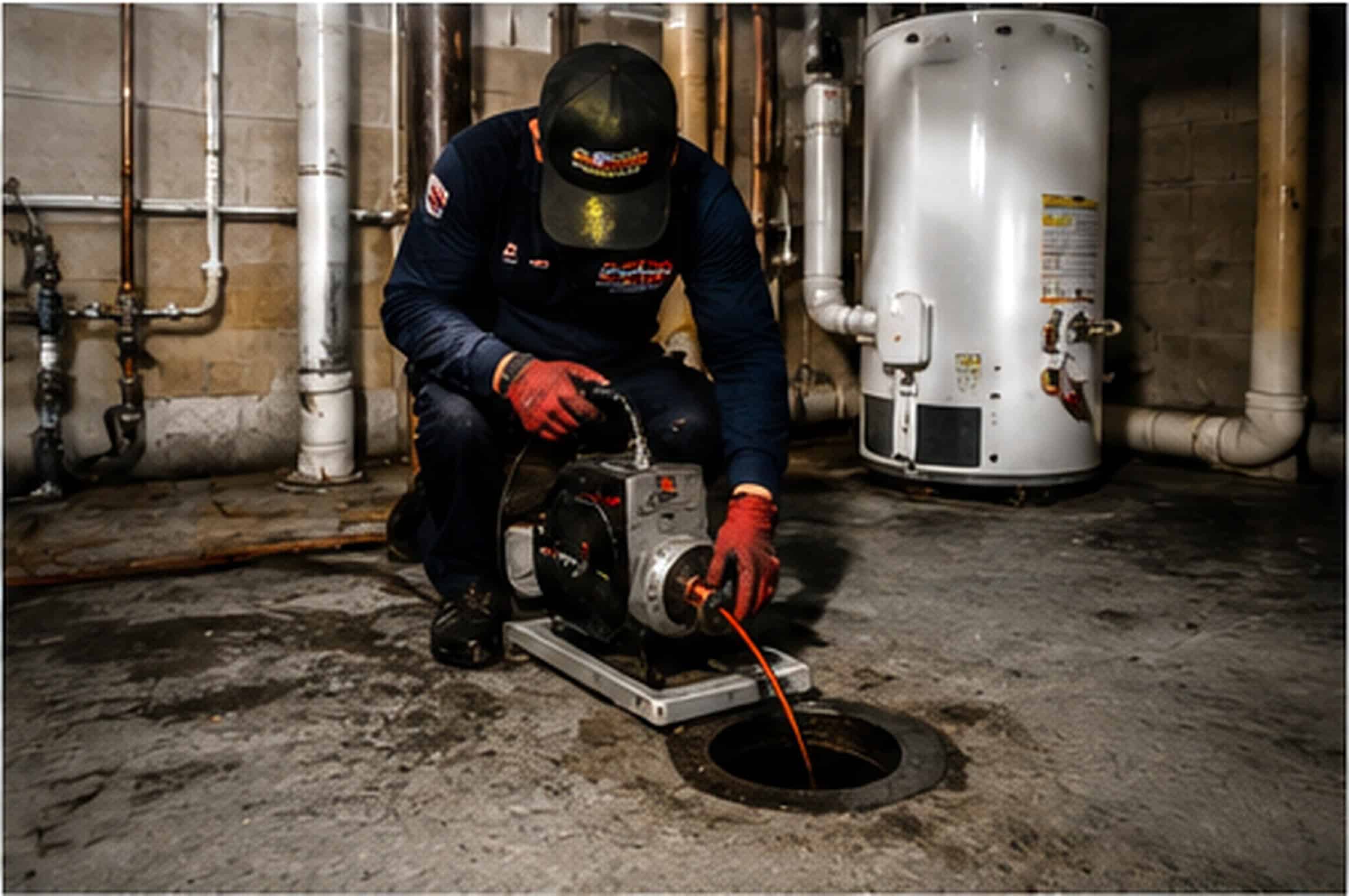
If you’ve had your sewer rodded two or three times in the past few years and the backup keeps returning, the problem isn’t that the plumber did a bad job. It’s that rodding only clears a path through the blockage — it doesn’t address the pipe wall condition that created the blockage in the first place.
When cast iron corrodes, the interior surface becomes rough and irregular. That texture grabs onto grease, hair, soap scum, and debris the same way a rough wall catches dust. After rodding, the path is clear — but the surface is still rough, and it immediately starts accumulating new buildup. Six months later, you’re back to a slow drain. A year later, you’re calling a plumber again.
This is where sewer line cleaning with hydro jetting makes a meaningful difference. At water pressures exceeding 4,000 PSI, hydro jetting doesn’t just punch through the blockage — it blasts the buildup off the pipe walls, leaving the interior significantly cleaner than rodding ever could. For aging cast iron, that matters. A cleaner pipe surface accumulates debris more slowly, which means longer intervals between service calls and a clearer picture of what the pipe actually looks like underneath all that buildup.
After a hydro jetting service, a camera inspection can show you the true condition of the pipe wall — whether there are cracks, joint separations, or sections that have bellied and need attention. That combination of jetting and camera inspection is how you get from “I keep having the same problem” to “now I actually know what I’m dealing with.” It’s the difference between treating a symptom and diagnosing the underlying condition.
Chemical drain cleaners are not a safe alternative for aging cast iron. Products with sulfuric acid generate heat when they react with water, and that thermal shock can crack old, brittle pipe. Using them repeatedly on a cast iron system that’s already compromised accelerates the deterioration rather than solving it.
Most conversations about aging pipes in Cook County focus on the sewer line — the cast iron drain stack and lateral that runs from the house to the city main. But homes built before the 1960s typically also have galvanized steel supply pipes, and those are failing on a similar timeline for similar reasons.
Galvanized pipe was the standard for water supply lines throughout Cook County from roughly the 1890s through the early 1960s. It’s now anywhere from 60 to 130 years old in the homes where it’s still installed. As the zinc coating depletes and the steel corrodes, mineral scale from Cook County’s hard water accumulates on the interior walls, narrowing the bore and restricting flow.
Low water pressure, discolored water, and uneven flow between fixtures are the most common signs. If your home has both cast iron drains and galvanized supply lines — which is the norm for pre-1970 Cook County housing stock — you’re looking at two separate aging pipe systems that may both need attention.

The number you’ll often see cited is 80 to 100 years. That’s the manufacturer’s figure under ideal conditions — stable soil, moderate climate, clean water, regular maintenance. Cook County offers none of those things. The clay soil moves constantly. The climate cycles between -15°F winters and 90°F summers. Chicago’s Lake Michigan water carries 130 to 150 parts per million of dissolved calcium and magnesium that deposits scale on every interior surface it touches. And most of these pipes have never been professionally cleaned.
In real-world Cook County conditions, cast iron drain pipes commonly start showing significant problems between 50 and 80 years of age. Homes built during the postwar boom — the bungalows, two-flats, and brick ranches that define neighborhoods from Marquette Park to Harvey to La Grange — went up between roughly 1940 and 1965. That puts their original cast iron plumbing squarely in the 60-to-85-year range right now. Not approaching the end of its life. Already in it.
The failure doesn’t usually announce itself dramatically. It builds. A drain that’s been slow for two years. A basement that floods during heavier rain than it used to. A gurgling sound when you flush. A faint sewer smell near floor drains. These aren’t minor inconveniences to monitor — they’re the pipe telling you something.
The homeowners who end up with the worst outcomes are typically the ones who waited until a complete backup forced the issue, at which point a manageable repair has often become a much larger one. We generally recommend getting a camera inspection on any sewer system that’s 50 years old or older, and repeating it at least every five years after that. A camera inspection gives you an actual picture of what’s happening inside the pipe — not a guess, not a general recommendation based on the home’s age, but documented footage you can see and understand. That’s the only way to know whether you’re looking at a pipe that needs cleaning, a pipe that needs descaling, or a pipe that’s reached the point where repair or replacement is the right call.
One thing that surprises a lot of Cook County homeowners: cast iron pipe isn’t just old infrastructure that’s being phased out. Under the Chicago Plumbing Code — specifically Section 18-29-702 — cast iron pipe is explicitly permitted for underground use in the public way. PVC, which is the default in newer construction across most of the country, is not approved for underground building and vent pipe under Chicago’s code. That means cast iron isn’t going away in this city. It’s still code-compliant, it’s still being installed, and it will remain the material in the ground under Cook County properties for decades to come.
What that means practically is that understanding cast iron — how it ages, how Cook County’s specific conditions affect it, and how to maintain it — isn’t just useful for homeowners with old pipes. It’s relevant to anyone who owns property in Cook County, period.
It also means that when a plumber recommends replacing your cast iron with PVC without discussing the code implications, that’s worth a follow-up question. Any work done on underground building pipe in Cook County needs to be done by a licensed plumber who knows the local code and pulls the appropriate permits. Work that isn’t permitted and code-compliant can create problems when you sell the property or make a homeowner’s insurance claim.
The right approach — camera inspection first, diagnosis based on what the footage actually shows, written estimate before any work begins, and a clear explanation of your options — is what separates a professional evaluation from a sales call. If a plumber recommends a full sewer line replacement without first running a camera, they’re guessing. And the guess financially favors them, not you.
If your Cook County home was built before 1970 and you’ve never had a camera inspection done on your sewer line, that’s the most useful next step you can take. Not because something is definitely wrong, but because you genuinely don’t know — and the cost of finding out is small compared to the cost of finding out the hard way.
The signs worth taking seriously are the ones that keep coming back: recurring drain backups, basement flooding after heavy rain, slow drains that don’t respond to cleaning, gurgling sounds, or a persistent sewer odor near floor drains. Any one of those, in a pre-1970 home, is worth a professional look.
We’ve been working on Cook County’s aging plumbing systems since 2000 — in the bungalows and two-flats of the Southwest Side, in the brick ranches of Berwyn and Cicero, in the older homes throughout Cook County where cast iron and galvanized pipe are still doing their jobs, for now. If you want to know what’s actually going on in your pipes before it becomes an emergency, reach out. We’ll show you what we find.
Article details:
Share:
Continue learning: