Chicago's combined sewer system has a breaking point lower than most homeowners realize — and your private sewer lateral is the one part of it you actually control.
Share:

Summary:
You come downstairs and there’s water on the basement floor. Maybe it smells. Maybe it’s coming up through the floor drain. You didn’t leave a faucet running. It rained last night — not a severe storm, just a normal summer rain — and somehow your basement flooded anyway.
This happens to tens of thousands of Cook County homeowners every year, and most of them don’t fully understand why. The reason basements flood in Chicago is specific to this region’s infrastructure, and once you understand it, the path forward gets a lot clearer.
When it rains in Chicago, the water has to go somewhere. In most modern cities, stormwater and sanitary sewage travel through separate pipe systems. Cook County’s system — built largely before 1930 — combines both in the same pipes. That means when a summer storm hits, rainwater from streets, rooftops, and driveways flows into the same underground pipes that carry sewage away from your home.
The Metropolitan Water Reclamation District of Greater Chicago has documented that this combined system gets overwhelmed by just two-thirds of an inch of rainfall in one hour. That’s not a major storm. That’s a routine summer afternoon in Cook County, IL. When the system hits capacity, pressure reverses — and water has nowhere to go but back up through the lowest point in your home. For most Chicago bungalows and two-flats, that lowest point is the basement floor drain.
Two things make Cook County particularly prone to this problem, and both of them have gotten worse over time.
The first is impervious surface coverage. Roughly 42% of Cook County is covered by pavement, rooftops, parking lots, and other hard surfaces. When it rains, almost none of that water absorbs into the ground — it all flows directly into the sewer system at once. Contrast that with a less developed area where grass and soil absorb a significant portion of rainfall before it ever reaches a pipe. In Cook County, the sewer system has to handle the maximum possible volume from the moment rain starts falling.
The second factor is storm intensity. Heavy rain events are happening more frequently in the Chicago area than they did decades ago. The infrastructure wasn’t designed for this, and it hasn’t been meaningfully upgraded to match it. The MWRD’s Deep Tunnel project — 110 miles of underground tunnels connecting to three massive reservoirs — was built to capture overflow and hold it until treatment plants can process it. It has helped. But the tunnels fill up too, and when they do, backup events still happen across Cook County.
The five community areas that see the worst recurring sewer backup flooding in Chicago are Chicago Lawn, Gage Park, West Lawn, Garfield Ridge, and Chatham — all on the Southwest and South sides of the city. Following a single significant storm, nearly 4,800 complaints for water in basements were filed through Chicago’s 311 system. That’s not a freak occurrence. That’s the system doing what it does when it rains hard enough.
If you own a Chicago bungalow or a two-flat in any of these neighborhoods, your home almost certainly has an original clay tile sewer lateral that’s now somewhere between 80 and 100 years old. These pipes crack, shift, and collect root intrusion and grease buildup over decades. A lateral that’s even partially blocked dramatically increases the pressure that builds up in your pipes during a combined sewer event — and that dramatically increases your risk of a backup.
Before you can fix the problem, you need to know which problem you actually have. Not all basement water intrusion comes from the sewer system, and the solution depends entirely on the source.
Sewer backup typically shows up through the floor drain — sometimes with a sewage odor, often during or shortly after heavy rain. The water is coming backward through your drain line because the pressure in the sewer system has reversed. This is a combined sewer overflow event, and the fix involves your private sewer lateral, a backwater valve, or both.
A sump pump will not stop a sewer backup. This is one of the most common misconceptions we encounter: homeowners install a sump pump after a backup event and then flood again the next time it rains hard, because a sump pump is designed to handle groundwater, not sewage coming up through your drain.
Groundwater intrusion is different. This is water seeping up through the floor slab or in through foundation cracks — typically odorless, often appearing even when it hasn’t rained recently. It’s caused by hydrostatic pressure from a high water table or saturated soil pressing against your foundation. This is where a sump pump is the right tool.
Internal plumbing failures — a burst pipe, a failed water heater, an overflowing appliance — are a third category entirely, unrelated to what’s happening outside. These can happen any time of year, including winter when frozen pipes burst after a thaw.
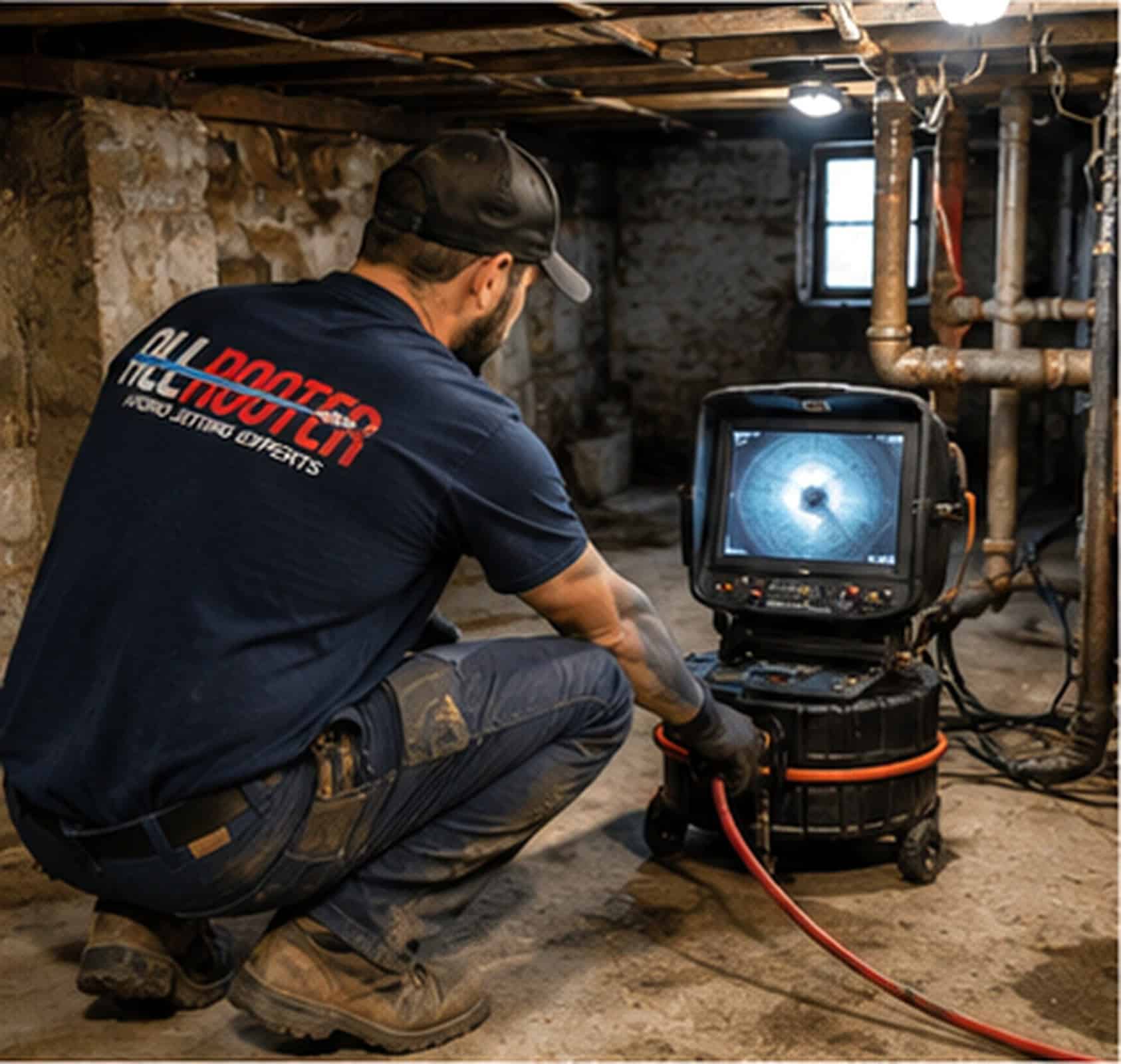
Knowing which type you’re dealing with changes everything about how you respond. A camera inspection of your sewer lateral is often the fastest way to get a clear answer, and it’s the first thing we recommend before any repair work begins.
Most conversations about basement flooding prevention focus on the city’s infrastructure — the combined sewer system, the Deep Tunnel, what the MWRD is or isn’t doing. What gets overlooked is the one part of the system that’s entirely your responsibility and entirely within your control: your private sewer lateral.
The lateral is the pipe that runs from your home to the city’s main sewer line in the street. Everything that happens inside that pipe is on you, not the city. And in a neighborhood full of 80- to 100-year-old homes throughout Cook County, that pipe has probably never been properly cleaned.

Here’s something that doesn’t get explained often enough: you don’t need a completely blocked lateral to have a serious flooding problem. A lateral that’s 40% or 50% restricted by grease buildup, root intrusion, or mineral scale still allows water to flow under normal conditions — so you might not notice anything is wrong until a heavy rain event hits.
When the combined sewer system is already under pressure during a storm, that partial blockage becomes a critical factor. Water and sewage that would otherwise move through your lateral and out to the main can’t move fast enough. Pressure builds. The path of least resistance is backward — up through your floor drain and into your basement.
Tree roots are one of the most common causes of sewer blockage in Cook County, IL. Roots from trees in parkways and yards follow the moisture in sewer pipes and work their way in through joints and small cracks — especially in older clay tile laterals. Grease accumulation is another major factor, particularly in homes where cooking grease has been going down the kitchen drain for decades. Neither of these problems announces itself before a flood event. You find out when the basement is wet.
Mechanical snaking — the kind where a rotating blade is fed through the pipe — can punch a hole through a clog and restore some flow. But it leaves residue on the pipe walls and doesn’t address root fragments or grease coating the interior. Hydro jetting uses pressurized water at over 4,000 PSI to scour the pipe walls completely clean, removing buildup, root material, and debris rather than just pushing through it. The result lasts significantly longer, and more importantly, it restores the full capacity of your lateral so it can actually move water during a storm event.
We always run a camera inspection before and after any hydro jetting service. Before, so we know exactly what we’re dealing with and can calibrate the pressure appropriately for your pipe material. After, so you can see for yourself that the line is clear.
Cleaning your sewer lateral is the most immediate, actionable step most Cook County homeowners can take — because it addresses the part of the system you actually own. But there are a few other things worth knowing, especially if you’ve already flooded once or you’re in one of the higher-risk neighborhoods on the Southwest Side.
A backwater valve (also called a backflow prevention valve) is a device installed on your sewer lateral that allows waste to flow out normally but physically blocks flow from reversing back into your home. When the combined sewer system surcharges during a storm, the valve closes automatically. It won’t help with groundwater intrusion, but for sewer backup flooding, it’s one of the most effective long-term solutions available.
Installation typically requires excavation and is a significant project — but Cook County offers a reimbursement program through the MWRD that can cover up to $3,000 (50% of cost) for backflow prevention valve installation, and up to $5,000 for overhead sewer system conversions. If you’ve been putting off this kind of work because of the cost, that program is worth looking into before you schedule anything.
Sump pump maintenance matters too, but with an important caveat: a sump pump only helps if your flooding is from groundwater, not sewer backup. If you’ve had your sump pump serviced and you’re still flooding during rain events, that’s a strong sign the water is coming from the sewer system, not the water table — and the solution is different.
Your homeowners’ insurance almost certainly doesn’t cover this. Standard homeowners’ policies explicitly exclude flood damage. Only about 4% of U.S. homeowners carry a separate flood policy, and many people find this out for the first time after a basement event has already caused tens of thousands of dollars in damage. That’s one more reason why proactive maintenance on your lateral is money well spent.
If you’re not sure what’s causing water in your basement, or if you’ve flooded before and want to understand your actual risk, a camera inspection of your sewer lateral is the right starting point.
Chicago’s basement flooding problem isn’t going away. The combined sewer system is aging, storm intensity is increasing, and the pavement covering Cook County, IL isn’t going anywhere. But understanding why it happens — and knowing that your private sewer lateral is something you can actually control — changes the conversation from helpless to actionable.
If your basement has flooded, or you’re in a neighborhood that floods regularly and you’ve never had your lateral inspected, that’s the place to start. A clear picture of what’s happening inside your pipes is worth more than any amount of guessing.
All Rooter Hydro Jetting Experts Inc has been working in Cook County since 2000, operating out of Archer Heights on the Southwest Side — the same part of the city that sees some of the worst sewer backup flooding in the region. If you want to talk through what’s going on with your basement or get a free estimate, reach out. We’re available around the clock, and we’ll tell you what we actually find before we recommend anything.
Article details:
Share:
Continue learning: