Not sure if you have a hidden leak — or just a hunch? Here's what leak detection actually involves, and why older homes in Cook County need a closer look.
Share:

Summary:
You probably didn’t search “leak detection” because everything is fine. Something tipped you off — maybe a water bill that jumped without explanation, a musty smell you can’t locate, or a damp patch on a wall that appeared out of nowhere. You’re not sure if it’s a real problem or something minor, and you don’t want to call a plumber and have them tear your house apart chasing a ghost.
That’s exactly what this guide is for. We’ll walk you through what leak detection actually is, how we find a hidden leak without demolishing your home to do it, and why — if you’re in Cook County, IL — the age of your pipes matters more than most people realize.
Leak detection is a diagnostic service. It’s not a plumber walking around with a flashlight and a hunch — it’s a structured process that uses specialized equipment to locate exactly where water is escaping from your plumbing system, often without opening a single wall.
The reason it exists as its own service category is simple: most leaks aren’t visible. They develop behind drywall, under concrete slabs, inside ceiling cavities, or along underground supply lines. By the time you can see the damage, the leak has usually been active for weeks or months. Professional detection finds the source before that damage compounds.
There are three primary tools that professional leak detection relies on, and understanding what each one does helps you know what to expect when our technician shows up at your door.
The first is electronic acoustic detection. Leaking water creates sound — even a slow pinhole leak produces a faint hiss or vibration as water moves through or escapes from a pressurized pipe. Acoustic detection equipment amplifies that sound far beyond what the human ear can pick up, allowing our plumber to trace the noise along a pipe run and narrow down the exact location of the breach. It’s the same principle as using a stethoscope, just far more sensitive.
The second is thermal imaging. Water that escapes a pipe changes the temperature of the surrounding material — a wet patch behind drywall will read differently than dry drywall on an infrared camera. Thermal imaging lets our technician scan walls, floors, and ceilings and see those temperature anomalies without touching anything. It’s particularly useful for slab leaks, where water migrates through concrete and shows up as a temperature variation on the floor surface above.
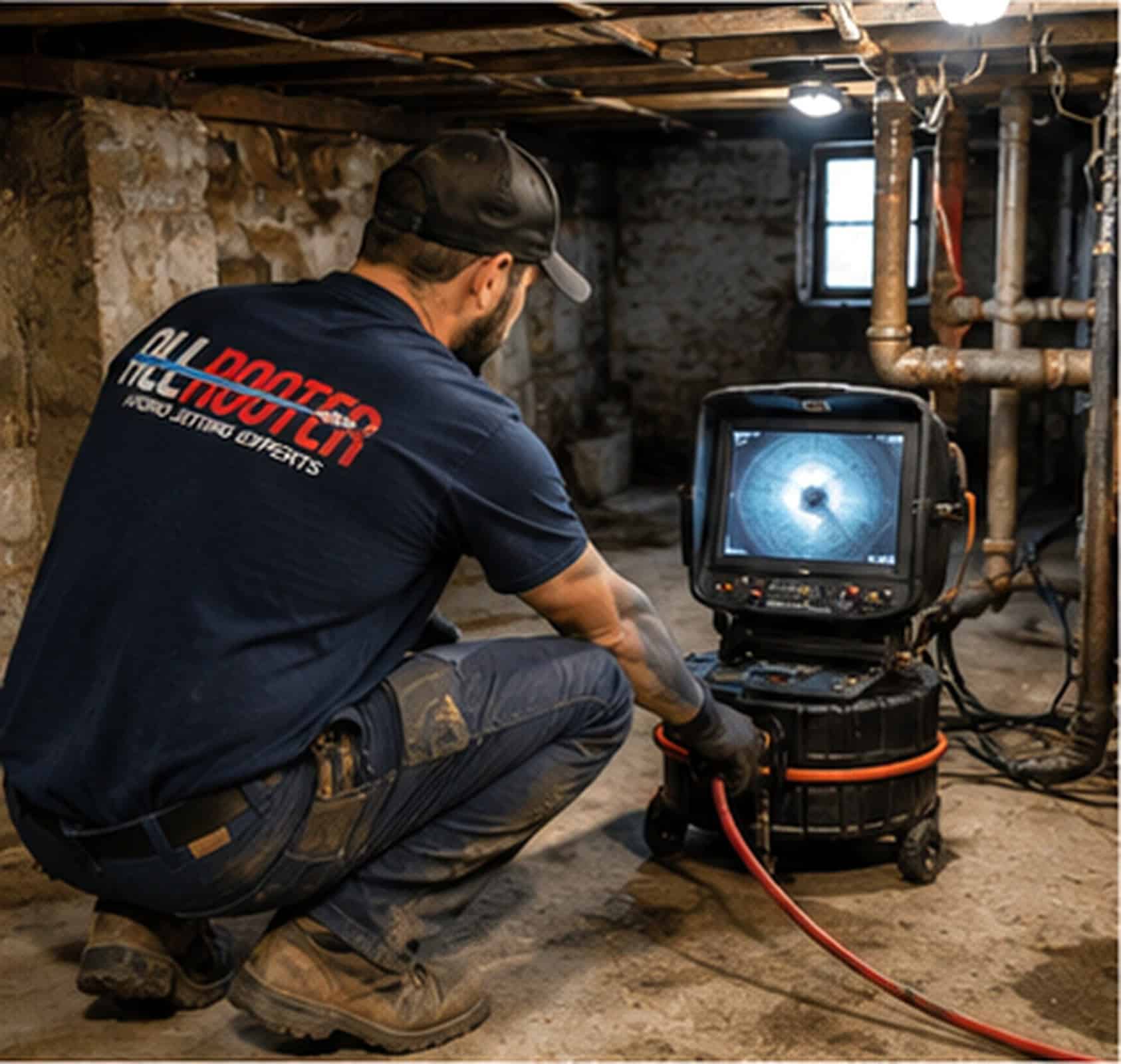
The third is video pipe inspection, also called camera inspection. A small camera is fed into the pipe — typically through a drain cleanout or access point — and transmits live footage of the pipe’s interior. This is most commonly used for sewer lines and larger drain pipes, where visual confirmation of a crack, root intrusion, or joint failure is more useful than acoustic or thermal data alone.
In practice, a thorough leak detection service often uses more than one of these methods. Our technician might use acoustic detection to narrow a leak to a general area, then thermal imaging to pinpoint it within a few inches. That combination is what separates a real diagnosis from an educated guess — and it’s the difference between a targeted repair and unnecessary demolition.
The most common trigger is a water bill that’s higher than it should be with no obvious explanation. A minor leak can increase your household water bill by around 10%, and because the increase happens gradually, it’s easy to dismiss it as seasonal variation until a few months have passed and the pattern is undeniable.
Beyond the bill, there are physical signs worth taking seriously. A musty smell in the basement or near an interior wall — especially one that doesn’t go away with ventilation — often means water has been present long enough for mold to begin. Soft spots in drywall, bubbling paint, or warped flooring near a bathroom or kitchen are late-stage signs that a leak has been active for some time.
A noticeable drop in water pressure throughout the house, not just at one fixture, can indicate a supply line leak somewhere in the system. There’s also a simple test you can do yourself before calling anyone. Locate your water meter and check the reading. Don’t use any water for two hours — no flushing, no running faucets, nothing. Then check the meter again. If the reading has changed, water is moving through your system somewhere it shouldn’t be.
One thing worth saying plainly: the average hidden leak goes undetected for more than 75 days. In that time, water is migrating into structural materials, creating conditions for mold, and in some cases working its way toward your foundation. Calling for a diagnostic check when you first notice something off is almost always less expensive and less disruptive than waiting until the damage becomes visible.
Cook County, IL has one of the oldest urban housing stocks in the Midwest. Chicago’s bungalow belt — the dense stretch of one-and-a-half-story brick homes running across the Southwest, Northwest, and North sides — was built largely between 1910 and 1940. Inner-ring suburbs like Berwyn, Cicero, Oak Park, and Harvey followed in the 1920s through 1950s. Many of these homes still have their original plumbing.
That matters because pipe materials have a lifespan. Galvanized steel — the standard supply pipe material through the mid-20th century — has a functional life of roughly 40 to 70 years. A galvanized pipe installed in a 1935 bungalow in Archer Heights or a 1948 two-flat in Berwyn is operating somewhere between 25 and 55 years past that window.
It doesn’t fail all at once. It corrodes from the inside out, narrows with mineral buildup, and eventually develops pinhole leaks — often in multiple spots along the same run. This is the reality we encounter regularly in Cook County homes, and it fundamentally changes how we approach leak detection and repair.
In a newer home with copper or PEX supply lines, a single leak is usually just that — a single leak. Find it, fix it, done. In a Cook County home with aging galvanized or cast iron plumbing, a single detected leak is often a symptom of broader pipe deterioration. The leak you can locate is rarely the only weak point in the system.
This changes the detection process in a few ways. First, acoustic detection in older homes sometimes picks up multiple anomalies, not just one — meaning our technician has to work more carefully to distinguish an active leak from a section of pipe that’s corroded but hasn’t breached yet. Second, the repair conversation is more nuanced. A targeted patch on a 90-year-old galvanized pipe may hold for a year before the section next to it fails.
A thorough diagnostic should give you enough information to make an informed decision about whether a targeted repair, a section replacement, or a full repiping makes more sense for your specific situation. Chicago’s winters add another layer. The freeze-thaw cycle that Cook County, IL experiences every year — temperatures swinging from below zero in January to the 40s in March — puts repeated stress on pipe joints. Each cycle expands micro-cracks slightly further and accelerates corrosion at joint connections.
This is why spring is one of the busiest seasons for hidden leak calls in our service area: damage that developed over winter often doesn’t make itself known until temperatures stabilize and water pressure normalizes. The clay soil that underlies much of Cook County also plays a role. Heavy clay expands when saturated and contracts when dry, creating lateral movement that stresses buried supply lines and sewer connections.
Underground leaks in Cook County aren’t rare — they’re a predictable consequence of the soil type combined with aging infrastructure. Video camera inspection is particularly valuable here, because it can confirm whether an underground line has shifted, cracked, or separated at a joint without any excavation.
A professional leak detection visit should follow a clear sequence. Our technician starts by gathering information — your symptoms, when you noticed them, whether the issue seems isolated to one area or spread across the house. That context narrows the search before any equipment comes out.
From there, the diagnostic process moves from least invasive to most. Acoustic detection equipment is typically used first to scan the pipe runs in the area of concern. If a thermal camera is warranted — particularly for slab or wall-cavity leaks — that comes next. For drain or sewer concerns, a camera inspection follows. The goal at every step is to locate the source with enough precision that any repair work is targeted, not exploratory.
Before any repair begins, you should receive a clear explanation of what was found, where the leak is located, and what your options are. That includes a written estimate with the cost of both detection and repair laid out before a single tool touches your plumbing. If a technician can’t tell you where the leak is before recommending that you open a wall, that’s not a leak detection — that’s a guess with a labor charge attached.
What if we don’t find anything? That’s a legitimate outcome. If acoustic and thermal detection show no anomaly and your meter test was inconclusive, we’ll tell you that clearly and explain what to watch for going forward. A clean result isn’t a wasted call — it’s a confirmation that you don’t have an active hidden leak, which has real value when you’re trying to understand what’s happening with your water bill.
For Cook County, IL homeowners dealing with older homes, it’s also worth asking whether the technician has experience with galvanized and cast iron systems specifically. The detection process isn’t dramatically different, but interpreting what the equipment finds in a 1930s pipe system requires familiarity with how those materials fail — which is different from how modern copper or PEX fails.
If something feels off — the bill, the smell, the pressure, the damp spot — trust that instinct. You don’t need a gushing pipe or visible water damage to justify a professional look. Modern detection equipment is designed specifically for the scenario where you suspect a problem but can’t confirm it, and a thorough diagnostic gives you a real answer either way.
For homeowners in Cook County, IL, where a large share of the housing stock is operating on plumbing that was never designed to last this long, early detection isn’t just practical — it’s protective. Finding a leak before it reaches your subfloor, your foundation, or your drywall is almost always a smaller problem and a smaller repair than finding it after.
All Rooter Hydro Jetting Experts Inc has been working in Cook County since 2000, and we understand what aging Chicago-area plumbing actually looks like from the inside. If you have questions or want to schedule a diagnostic, we’re available around the clock — including weekends and holidays. Reach out and we’ll give you a straight answer before any work begins.
Article details:
Share:
Continue learning: